Follow us:
DR. BICKMORE'S YA WEDNESDAY
  • Wed Posts
  • PICKS 2026
  • Con.
  • Mon. Motivators 2025
  • WEEKEND PICKS 2024
  • Weekend Picks 2021
  • Contributors
  • Bickmore's Posts
  • Lesley Roessing's Posts
  • Weekend Picks 2020
  • Weekend Picks 2019
  • Weekend Picks old
  • 2021 UNLV online Summit
  • UNLV online Summit 2020
  • 2019 Summit on Teaching YA
  • 2018 Summit
  • Contact
  • About
  • WEEKEND PICKS 2023
    • WEEKEND PICKS 2023
  • Bickmore Books for Summit 2024


Check out our weekly posts!

Stay Current

Deepening Literature Study by Teaching with Primary Sources Twelve Angry Men and the Evolving History of a “Jury of Peers”

9/30/2026


Meet out Contributors

Dr. Julianna Lopez Kershen is an Assistant Professor of Instructional Leadership and Academic Curriculum at the University of Oklahoma, where she teaches English language arts and literacy education courses. Her research explores core practices for literacy learning, bridging classrooms with academic inquiry. She received the 2024 Nilsen-Donaldson Award for scholarship in YA literature from The ALAN Foundation and is an AERA-AIR Fellow in the Study of Deeper Learning. Her teaching and research are closely connected, with publications in Teachers and Teaching, English Education, English Teaching: Practice and Critique, English Journal, The ALAN Review, Children’s Literature in Education, and Contemporary Issues in Technology and Teacher Education. [email protected]
Picture
 Jackson Hall is a Senior Language Arts Education major at the University of Oklahoma. Jackson is an undergraduate researcher in the Honors Research Assistant Program in the Honors College at OU, working with Dr. Kershen on teaching with primary sources.
[email protected]
Picture
Kacy M. Price is a graduate student at the University of Oklahoma studying visual literacy in the department of Instructional Leadership and Academic Curriculum. She previously taught high school English for five years in Oklahoma and currently works as a Graduate Research Assistant with Dr. Kershen and is a Teaching Assistant with the Oklahoma Writing Project. [email protected]
Picture

Deepening Literature Study by Teaching with Primary Sources
Twelve Angry Men and the Evolving History of a “Jury of Peers”
by Julianna Lopez Kershen, Jackson Hall, and Kacy M Price

Reginald Rose's teleplay Twelve Angry Men (1955, screenplay 1957) is often taught in high school classrooms as a character study or a lesson in rhetoric and persuasion. Teachers and students grapple with questions over which juror applies persuasive moves to whom, and how characters evolve and respond to rhetorical pressures. But the play is also a dramatization of an 800-year-old unresolved question that the American legal system has never fully settled: what, exactly, is a jury of peers, and who gets to decide who qualifies as a peer? Pairing the play with a curated set of primary source texts allows students to read Rose's twelve unnamed jurors not as isolated fictional characters, but as the latest entry in a long historical argument—one that was still being fought in real courtrooms the same year Rose wrote his teleplay—and is still evolving today.
Picture
Twelve Angry Men (Rose 1957/2006) Penguin Random House.

Why Teach Literature with Primary Sources and Visual Texts?

Existing empirical research explores how humanities teachers (e.g., ELA and social studies) integrate visual texts in instruction to support student learning and comprehension of disciplinary content (Brugar, 2017; Capello & Walker, 2016; Guo et al., 2024; Pantaleo, 2015; Roberts & Brugar, 2014; 2017). Brugar (2017) surveyed K-12 social studies teachers who reported using artifacts, diagrams, graphs, illustrations, maps, and other visual texts, finding that many integrated primary sources and visual texts for largely decorative purposes and initial student engagement. Guo et al. (2024) explored how ELA and social studies preservice teachers used visuals for instructional purposes, finding they most often used them to conduct teacher-led activities, such as aiding lectures or prompting student recall. Using visuals to conduct student-centered activities such as student presentations or discussion were present but occurred least often in PST lesson plans (Guo et al., 2024). Further empirical work examines the influence of visual texts on literacy development in elementary grades (Roberts & Brugar, 2014; Roberts & Brugar, 2017) finding that students require explicit, direct instruction about how to interpret visual texts. Similarly, Pantaleo (2015) found that when provided with the opportunity and instruction in ELA class, students were able to develop awareness of the characteristics of visuals that influence understanding and meaning. This brief overview indicates that learning activities can be deepened with the inclusion of primary sources, data visualizations, and visual texts, and importantly, that teachers should thoughtfully select, curate, and integrate these materials to serve disciplinary learning, community building, and student curiosity.
The Library of Congress and National Archives are both essential resources for English language arts teachers looking to extend, critique, and intensify literature study in their classrooms through the inclusion of primary source documents and visual texts. The Library of Congress devotes considerable resources to supporting educators to research, select, and curate primary sources for classroom instruction. The TPS Collective has ample practical, peer-reviewed resources teachers can explore for lesson planning ideas, as well as a collection of reflective practice articles. ELA teachers building their familiarity with visual literacy and primary source integration can begin with the Library of Congress’s Primary Source Analysis Tool to support students' critical analysis and ability to engage in slow looking.
Slow looking is defined by Shari Tishman (2018) as “taking the time to carefully observe more than meets the eye at first glance” (p. 2). Tishman (2018) argues that the act of slow looking is a “mode of learning” and through sustained observation we gain “knowledge about the world” that supports critical thinking skills (p. 2). She presents three reasons why it is important for us to attend to slow looking: it is a “counterbalance to our habit of “fast looking,” it’s typically “underemphasized in general education,” and that—as humans—we share the value of “careful observation” (Tishman, 2018, p.  5-7). Tishman (2018) believes that slow looking is a skill we are all capable of learning which can deepen our understanding of ourselves and the world around us. Connected to the concept of slow looking, the work of Capello and Walker (2016) explores upper elementary and middle school teachers’ use and perceptions of Visual Thinking Strategies (VTS) finding visuals to be valuable tools for teaching “core curriculum” and increasing accessibility for all learners.
 Educator resources at the National Archives also support document analysis and interdisciplinary study of literature through civics education, history and historical perspectives, and place-based lenses that widen the interpretive aperture of literary texts. Widening a reader’s gaze takes them both into and beyond the text, inviting students to consider the time, place, and intention of the author as well as larger social/cultural movements and historical events. We also refer to Smithsonian resources, including art from the National Portrait Gallery, as visual texts to electrify classroom conversation and help students orient the modern moment to historical contexts.
Picture
12 Angry Men film poster. 1957.
In the following sections we use Twelve Angry Men by Reginald Rose as a shared whole-class text study organized around two essential questions. In addition to using the film version of the teleplay, our goal is to highlight primary source documents that would support inquiry and enrichment through visual text investigation. Our hope is that this multimodal text set serves as an example of how ELA and humanities teachers can curate texts for powerful interdisciplinary investigation that deepen our connections to literature and push us out into the world.

Two essential questions, two different kinds of evidence

Teaching Twelve Angry Men with a curated set of primary source documents and visuals enriches students inquiry into any number of essential questions (EQ), including the ones guiding this example. To investigate the EQ: What is a jury of peers? we propose examination of a series of aspirational, philosophical documents and visual texts including paintings of John Adams and Thomas Jefferson, accompanying their words describing representative government and trial by jury.

​The second President of the United States, John Adams, writing in the Clarendon Letters stated that trial by jury was “the heart and lungs of liberty.” Early American leaders, held firm views about the value of trial by jury, established in the 1215 Magna Carta (described below) and reaffirmed in the 1689 British Bill of Rights. However, as the American Revolution increased in power, Great Britain responded by taking away the right to trial by jury. The 1765 Stamp Act forced colonists who violated that law to appear in admiralty courts with no juries.  Colonists issued a formal response to Parliament, protesting with the call of “no taxation without representation.”  Trial by jury was understood to be an “inherent and invaluable right” of every British subject in the Colonies.

Picture
Image 3 of The Stamp Act, 1765. Library of Congress.
Picture
A view of the obelisk erected under Liberty-tree in Boston on the rejoicings for the repeal of the ---- Stamp Act 1766. Library of Congress Prints and Photographs Division.
Picture
Patrick Henry before the Virginia House of Burgesses May 30, 1765, Engraving by Jones, Alfred,1852. Title from original painting by Peter F. Rothermel after which the engraving was made. Painting in collection of Red Hill, Patrick Henry National Memorial, Brookneal, Virginia. Engraving, Library of Congress Prints and Photographs Division.
Picture
President John Adams, artist unknown; National Portrait Gallery, Smithsonian Institution.
Thomas Jefferson, writing to Thomas Paine, July 11, 1789, described the need for trial by jury to be taken up as legal practice across the fledgling country; stating, “the trial by jury . . . I consider that as the only anchor, ever yet imagined by man, by which a government can be held to the principles of it’s constitution.” Jefferson’s emphasis, and the fervent belief of other founders, that trial by impartial jury, the right not to incriminate oneself, and the protection against double jeopardy became integral components of the Bill of Rights. Rose's play and the jurors within it engage, debate, and contradict these beliefs in real time. In Act II, the 10th Juror shows clear prejudice against the defendant and people like him:

That kid on trial, his type, they’re multiplying five times as fast as we are. Thet’s the statistic. Five times. And they are-wild animals. They’re against us, they hate us, they want to destroy us.... if we don’t smack them down whenever we can, then they are gonna own us. (p. 65).
​
The 10th Juror has already decided how he feels about the defendant simply because of where the defendant lives.
In Act I, the 3rd Juror hints at his inability to remain impartial by explaining the strained relationship he has with his son, who is about the same age as the defendant, "He's twenty... when he was sixteen we had a battle. He hit me in the face. He's big y'know. I haven't seen him in two years. Rotton kid." (p. 17-18). The 3rd Juror is projecting the issues he has with his son onto the case which made it personal for him. This has caused him to become an unfairly harsh and biased juror.

​Jefferson’s entire letter can be found in the National Archives Founders Online collection.

Picture
Thomas Jefferson by David Edwin after Rembrandt Peale, 1801; National Portrait Gallery, Smithsonian Institution.
Students reading the play can consider the importance across time periods of trial by jury. Why would the early founders of the United States be so committed to this concept? How do the jurors in the play respond to the 8th juror’s honest confusion and concern over his feelings of responsibility in acting as a juror? Other jurors want to rush ahead with their decision; “it’s practically all said already. We can talk about it forever.” (7th Juror, p. 17) and “Listen, I don’t see what all this stuff about the knife has to do with anything. Somebody saw the kid stab his father. What more do we need? I got three garages of mine going to pot while you’re talking. Let’s get done and get outa here” (10th Juror, p. 25).
​
Students can also explore The Magna Carta Project, especially Magna Carta’s Clause 39 (written in 1215). Clause 39 is the first appearance of the phrase “judgment of his peers” as legal language relating to trials. Clause 39 stands as the precedent for what will become every American’s right to trial by jury of peers. The concept of trial by jury travels forward across hundreds of years, being affirmed and written into the United States Constitution. While reading Twelve Angry Men students can explore a direct textual lineage from 13th-century England to America’s founding documents and the modern courtroom. 

Through the Library of Congress Rare Book and Special Collections Division, Students can view James Madison’s personal copy (1789) of the Proposed Articles of Amendment to the Federal Constitution, which would become the first ten amendments, known as the Bill of Rights. 

​The Magna Carta was written in the early 13th century by feudal lords of England who were outraged by King John’s heavy fees and taxes, which were imposed to pay for wars that he was losing. This caused the barons to rebel and forced the king to sign the Magna Carta in 1215, which limited the monarchy’s powers to raise taxes on their own accord and guaranteed a trial by jury. The founding fathers of the United States of America used the Magna Carta as a legal framework for their newly declared free country. The Bill of Rights later amended to the Constitution includes many rights directly modeled after the Magna Carta, such as the sixth amendment, which guarantees a speedy and fair trial. 
Picture
A bill of rights as provided in the ten original amendments to the constitution of the United States in force December 15, 1791. Created in 1950. Library of Congress Printed Ephemera Collection; Portfolio 244, Folder 44.
The United States hosted the Lincoln Cathedral Magna Carta for the 1939 New York World’s Fair. British government saw this exchange as an opportunity to strengthen ties with the United States during the rising crisis in Europe. This effort was cultural and historical as much of both legal systems and citizen’s rights were influenced by the Magna Carta. The British Magna Carta’s stay in the United States was extended due to risks from travel during wartime. It traveled from New York to the Library of Congress, with consent of President Franklin D. Roosevelt, and was later returned to Lincoln Cathedral in 1946.
Picture
Title: Public views Magna Carta after deposited in Congressional Library. Washington, D.C., Nov. 28, 1939. Shortly after the historical Magna Carta was placed in the Congressional Library for safekeeping by British Ambassador Lord Lothian. Today the public was allowed to view it under the watchful eyes of library guards. Library of Congress. https://www.loc.gov/pictures/item/2016876673/
A second EQ, Who defines “peers”? can be explored with students through a very different, more complex set of primary source texts. This exploration highlights the patriotic core conveyed through Rose’s play and the theme that all people are deserving of equal rights, opportunities, and humanity. The following set of documents for inquiry demonstrates how within American jurisprudence, the idea of who constitutes a jury of peers and who can and should define “peers” has dramatically changed over time.

The Assize of Clarendon (1166) is worth starting with, even though it predates the Magna Carta, because it reframes the question and aligns with the positions of some jurors in Rose’s text. The Assize of Clarendon makes clear that the earliest juries weren't impartial deciders at all, but local informants reporting their neighbors while under oath. In other words, previously, jurors acted as witnesses and accusers, not impartial fact-checkers. This short video by Annenburg classroom summarizes the English History of Juries presents the Assizes and how King Henry’s writings shifted earlier concepts of what it meant to be a juror.
​
In the United States, the concept of what it means to be a juror, who can be a juror, and what defines a “jury of peers” has changed over time. American legal history outlines a path of exclusion from juries: colonial slave codes barring enslaved and free Black people from testifying or serving; the Constitution's Fugitive Slave Clause; then Strauder v. West Virginia (1880) striking down explicit racial exclusion. However, Norris v. Alabama (1935), also known as the Scottsboro case, proved racial exclusion was still practiced. The Scottsboro Nine were convicted of crimes they never committed. In 1935, the Supreme Court overturned the verdict in Norris v. Alabama which stated that the trials had been unfair because there were no Black men on the jury. This case would eventually help lead to the integration of juries. The Scottsboro cases have a long legal history. 

Picture
A grand jury indicted within a week (from left) Clarence Norris, 19; Olen Montgomery, 17, Andrew Wright, 19 Willie Roberson, 17, Ozie Powell, 16, Eugene Williams, 13, Charlie Weems, 19, Leroy Wright, 13, and Haywood Patterson,18. Bettman, Getty Images.
On April 19, 2013, Alabama Governor Robert Bentley signed legislation officially pardoning and exonerating all nine Scottsboro Boys. Their bravery should inspire high school readers, as themes of prejudice and preconception are woven throughout Rose’s text.
Picture
U.S. Reports: Norris v. Alabama, 294 U.S. 587 (1935). Library of Congress.
The Fourteenth Amendment and the Civil Rights Act of 1875 created space for wider groups of people to serve as jurors; yet the Civil Rights Cases of 1883 then rescinded those rights. Students can also investigate additional distinctions between legal precedence and exclusionary everyday practice – as when considering the Nineteenth Amendment (1920), students may assume it put women on juries. However, the honest answer is that it didn’t, not really, not until Taylor v. Louisiana in 1975 finally struck down laws letting women opt out by default. The United States’ history of legal exclusion and loopholes is still very present. The Thirteenth Amendment was set to purge slavery from the U.S., except through the means of criminal punishment. This criminal punishment clause still exists today.
Picture
Title. 13th Amendment to the U.S. Constitution: Abolition of Slavery (1865).
This Constitutional amendment, ratified in 1865, declared slavery illegal, except as a means for criminal punishment. Our current criminal justice system still includes acts of inequality and unfairness, as some would argue that prisoners within state and federal prisons can work for little to no pay.
Picture
Nineteenth Amendment to the United States Constitution.
The Nineteenth Amendment, ratified in 1920, declared that the right to vote could not be infringed on account of sex. This became the first big leap in women's rights, as it allowed women to have their own influence in American politics and laws. However, only after the 1975 Taylor v. Lousiana decision was it confirmed in statute that women had the right to serve on juries.
Picture
U.S. Reports: Taylor v. Louisiana, 419 U.S. 522 (1975). U.S. Reports: Taylor v. Louisiana, 419 U.S. 522 (1975). | Library of Congress Library of Congress.
Supplementing a shared reading of Twelve Angry Men with primary source documents can enrich students’ understanding of the play’s themes, while also building civic education. Our suggestions are only introductory ideas for collaborating with your students and colleagues to build an interdisciplinary text set that asks new questions and excites readers. The responsibility of serving as a juror is a core civic service to our communities for all Americans. Investigating visual texts and primary sources can develop critical analytic skills through slow looking and parsing the text features and rhetorical/visual structures used by artists, writers, and historical figures. We leave you with the words of the 8th Juror, speaking on behalf of the power of trial by jury:

It’s very hard to keep personal prejudice out of a thing like this. And no matter where you run into it, prejudice obscures the truth. . . Nine of us now seem to think the defendant is innocent, but we’re just gambling on probabilities. We may be wrong. We may be trying to return a guilty man to the community. No one can really know. But we have a reasonable doubt, and this is a safeguard that has enormous value in our system. No jury can declare a man guilty unless it’s sure. (8th Juror, p. 66).

Graphic Memoirs of Migration, Giving Young Readers Historical and Humanizing Frames of Reference

9/23/2026


Meet our Contributor

Maite Urcaregui is an assistant professor of English and comparative literature at San José State University. Her research and teaching explore Latinx and multiethnic American literatures and comics through feminist, queer, and critical race theories and histories. She is co-editor with Fernanda Díaz-Basteris of Latinx Comics Studies: Critical and Creative Crossings (Rutgers University Press, 2025) and is currently working on her first book, which examines citizenship in multiethnic American graphic narratives.
Picture

Graphic Memoirs of Migration, Giving Young Readers Historical and Humanizing Frames of Reference by Maite Urcaregui

In a story from Minnesota Public Radio and Sahan Journal, teachers describe students disappearing from classrooms following increased ICE raids in the Twin Cities. According to Sahan Journal’s analysis, “as many as 1,700 students left the Minnesota school districts and charter schools with the highest percentage of English learners.” These empty desks visualize the effect of these ICE raids on children and families who feared deportation if they left home, a fear that is often hidden from public view, confined to homes and private spaces. As educators, how can we help our students make sense of these scenes of family separation and state-sponsored violence we’ve seen play out in the streets of Minneapolis and in other cities across the country? As scholars of young adult literature, what stories can we turn to for more humanizing images and frames of reference?
​
To respond to these questions, I find myself turning to comics and graphic novels, not just because I enjoy reading them but because I find, when faced with images of violence, their blending of word and image can create alternative visual and narrative frames of reference. As Alison Halsall argues in Growing up Graphic: The Comics of Children in Crisis, “graphic texts can humanize experiences of migration from the perspective of young people and affirm their experiences of displacement and diaspora in the process” (56). In this post, I review three young adult graphic memoirs by and about Latinx people that trace different historical moments and different experiences of migration, citizenship, and national exclusion and belonging in the U.S.
Picture

Francisco Jiménez, Andrew J. Rostan, and Celia Jacobs’The Circuit: Graphic Novel 
​1940s-60s

Picture
Picture
The Circuit: Graphic Novel Edition (2024) is a graphic novel adaptation of Francisco Jiménez’s autobiographical short story collection The Circuit: Stories from the Life of a Migrant Child (1997). The graphic novel portrays Francisco’s migration from Jalisco, Mexico, to the U.S. as a young child as well as his family’s constant migrations across central California as they pursue farmwork. While Francisco’s family initially migrate to the U.S. undocumented, his father eventually receives a temporary work permit that gives him relative protection, but Francisco, his mother, and his siblings are left undocumented and unprotected, and the threat of la migra and deportation looms. This threat is realized when the graphic novel concludes with Francisco and his older brother Roberto being removed from school by INS agents and awaiting deportation.
Historically, the graphic novel takes place mostly during the 1950s, the second century of the Bracero Program, which “resulted in an influx of undocumented and documented laborers.” Thematically, the text disrupts linear narratives of migration. The graphic novel opens with the family’s experience crossing the border and concludes with the brothers’ deportation, but these moments are given relatively little narrative attention. Instead, Jiménez chooses to focus on Francisco’s experiences within the U.S. as his family moves from camp to camp, in a never-ending circuit of survival. The graphic novel form also does an excellent job depicting Francisco’s experience as a Spanish speaker and English language learner in the classroom. In his early school days, for instance, English is shown as a cacophony of unintelligible words and abstract symbols in speech ballons. 

Pedro Martín’s Mexikid: A Graphic Memoir 
​1970s

Picture
Picture
Pedro Martín’s Mexikid (2023) tells the story of his family’s road trip in a Winnebago from Watsonville, California, to Pegueros, Jalisco, to bring their aging abuelito across the border to live with them. Pedro, the young protagonist and narrator, has a fantastically humorous voice, which will connect with young readers and punctuates this story of border-crossing with playful moments. Pedro is a gifted storyteller and a self-identified nerd, and he weaves family stories and photographs with popular culture (superhero comics, action figures, popular tv, etc.) together on the page to tell a multi-generational story of migration.
​
Historically, although Mexikid is set in 1977, it takes readers back to Mexico’s revolutionary history, picturing the longer histories that shape Mexican identity and immigration. As Pedro learns more about his grandfather’s experiences during the Revolution, he draws and, sometimes, embellishes these stories in the style of superhero comics. Thematically, the graphic memoir explores Pedro’s adolescent insecurities and his sense of place within his family. The text, while primarily in English, incorporates quite a bit of Spanish, along with footnoted translations, to represent the family’s bilingual experience. Finally, the graphic memoir depicts encounters with border patrol agents on both the U.S. and Mexico sides of border, but, like in The Circuit, the emphasis is not on the crossing per say but the longer journey, both literal and figuratively.

Just this month, Martín published a follow up titled Mexikid Dreams: A Graphic Memoir (2026), which explores his family’s experiences as farmworkers and Pedro’s dreams for his own future.

Alberto Ledesma’s Diary of a Reluctant Dreamer
1970s, 1980s, and 2010s

Alberto Ledesma’s Diary of a Reluctant Dreamer: Undocumented Vignettes from a Pre-American Life, published in 2017, blends the artist’s personal narrative of growing up undocumented with cartoons and reflections on the current political moment. Ledesma and his family immigrated to the U.S. in 1974 and eventually received citizenship through the amnesty provision of the Federal Immigration and Control Act of 1986. While recognizing the privileges and protections citizenship has afforded him, Ledesma reflects on the lasting effects of his undocumented youth, saying: “The twelve years that I spent living in the heart of East Oakland as an undocumented immigrant conditioned me in a profound way, and it deeply affected how I behaved as a student, an academic, and now, as a Berkeley staff member” (4). Many of the “undocumented vignettes” explore the tenuous way undocumented youth navigate educational settings, often becoming high achievers who, like Ledesma, are “hyper-documented” with educational degrees and awards to challenge deficit narratives of undocumented people.
 
Historically, Diary of a Reluctant Dreamer shows that it is possible to create pathways to citizenship and puts some of the federal policies of the past in conversation with our current moment, particularly in the aftermath of Trump’s first and second elections. Thematically, the text explores the invisible psychological and emotional consequences of being undocumented and forced to live “in the shadow,” as Ledesma says (38). These experiences are best illustrated, I believe, in a chapter of the book called “The Undocumented Alphabet.” In these series of single-panel cartoons, Ledesma harnesses the form of children’s picture books, specifically ABC books, to explore the experiences of undocumented children, youth, and their families and communities in ways that center their situated knowledges and epistemologies. 
Each of these graphic memoirs have different relationships to young adult literature. The Circuit, both the original short stories and the graphic novel adaptation (and I recommend reading and/or teaching both in tandem), sits on the edge of children’s and young adult literature, or “middle grade” (ages 8-12), although its nuanced discussions of labor politics, racial discrimination, and deportation will speak to older readers. Mexikid, a Newbery Honor Award Winner, is early young adult (ages 10-14) and captures all the insecurity, awkwardness, and humor of that age through Pedro’s first-person narration. Diary of a Reluctant Dreamer is not necessarily young adult literature. It features an adult narrator looking back on his undocumented youth through the distance of age and the protection of citizenship. That relationship between adult narrator and child protagonist, however, is at the heart of so much young adult literature, and I think Ledesma’s work illustrates some of the conversations around the adult author and child witness that have occupied YAL scholars.
 
These graphic memoirs of migration can help young readers look to the past to better understand our contemporary moment and the changing political realities that have compelled Latinx people to immigrate and have shaped their varied experiences of national belonging and exclusion. Their graphic memoir form, which visualizes the authors’ real, lived experiences on the page, can offer a humanistic counternarrative to the anti-immigrant discourse that plagues our national discourse. 
​There’s also something to be said of the role of fiction in this conversation. Jose Pimienta’s Twin Cities (2022) and Halfway to Somewhere (2025), Julio Anta and Jacoby Salcedo’s Frontera (2023), and Anta and Anna Wieszczyk’s Home (2021) are all great starting places, with Pimienta’s Halfway to Somewhere, a Stonewall Book Award Winner, being my personal favorite. 
Picture

Picture
Picture

Picture
Wherever you start, I hope these graphic memoirs and comics do more than dazzle and distract us with their images; I hope they direct us to challenge anti-immigrant narratives and take action in our own classrooms and communities.

Works Cited

Chavez, Herman Luis, and María Guadalupe Partida. “A Latinx Resource Guide: Civil Rights Cases and Events in the United States” (1942: Bracero Program), edited by Suzanne Schadl and María Daniela Thurber. Library of Congress, 17 Aug. 2020, https://guides.loc.gov/latinx-civil-rights/bracero-program. Accessed 11 Sept. 2026.
 
Dernbach, Becky Z., and Cynthia Tu. “‘Kids literally disappeared’: Minnesota schools lost at least 1,700 students following Operation Metro Surge.” MPR News, 1 Sept. 2026, https://www.mprnews.org/story/2026/09/01/sahan-minnesota-schools-lost-at-least-1700-students-after-ice-operation. Accessed 11 Sept. 2026.
 
Dernbach, Becky Z., and Cynthia Tu. “‘Kids literally disappeared’: Minnesota schools lost at least 1,700 students following Operation Metro Surge.” Sahan Journal, 31 Aug. 2026, https://sahanjournal.com/education/minnesota-schools-lost-1700-students-after-metro-surge/. Accessed 11 Sept. 2026.
 
Halsall, Alison. Growing Up Graphic: The Comics of Children in Crisis. The Ohio State University Press, 2023.
 
Ledesma, Alberto. Diary of a Reluctant Dreamer: Undocumented Vignettes from a Pre-American Life. The Ohio State University Press, 2017.

Works Referenced

Anta, Julio; Anna Wieszczyk; Bryan Valenza; and Hassan Otsmane-Elhaou. Home Vol. 1. Image Comics, 2021.
 
Anta, Julio, and Jacoby Salcedo. Frontera. HarperAlley, 2023.
 
Chavez, Herman Luis, and María Guadalupe Partida. “A Latinx Resource Guide: Civil Rights Cases and Events in the United States” (1986: Immigration Reform and Control Act of 1986), edited by Suzanne Schadl and María Daniela Thurber. Library of Congress, 17 Aug. 2020, https://guides.loc.gov/latinx-civil-rights/irca. Accessed 11 Sept. 2026.
 
Jiménez, Francisco. The Circuit: Stories from the Life of a Migrant Child. University of New Mexico Press, 1997.
 
Jiménez, Francisco, Andrew J. Rostan, and Celia Jacobs. The Circuit: Graphic Novel. Clarion Books and HarperAlley, 2024.
 
Martín, Pedro. Mexikid: A Graphic Memoir. Dial, 2023.
 
Martín, Pedro. Mexikid Dreams: A Graphic Memoir. Dial, 2026.
 
Pimienta, Jose. Halfway to Somewhere. RH Graphic, 2025.
 
Pimienta, Jose. Twin Cities. RH Graphic, 2022.

Asking Big Questions: Four Multimodal Novels to Shift the Way Students Compose

9/16/2026


Meet our Contributor

Lauren Vandever, M.Ed., works as a district instructional coach in rural Oklahoma, but in her heart, she is always in a 7th-grade classroom. Lauren is also a Ph.D. student in Literacies and Language Arts Education at Oklahoma State University. With 12 years of classroom experience, she is passionate about growing educators, fostering teacher efficacy, and exploring multimodality and meaningful literacy practices that support student learning. Outside of studying and teaching, Lauren enjoys running her nieces and nephews around, plus spending time with her wife, three dogs, and two cats. 
Picture

Asking Big Questions: Four Multimodal Novels to Shift the Way Students Compose by Lauren Vandever

When I started my PhD two years ago, I knew going in I wanted to work with middle school literacy and multimodality. What that meant at the time, I had no idea. But I knew those were two areas close to my heart that did not get enough attention from others.
​
As I have journeyed through my PhD program as a Literacies and Language Arts scholar, my professors and projects have pushed me to continually ask, “In what way do I want to write this?” Through this question, I have come to learn something important about myself: my methodology of expression is a/r/tography. A/r/tography is a methodology that encompasses multiple identities within one word. The first three letters of the word represent the three identities that a/r/tography encompasses: artist, researcher, and teacher. Each one of these identities sits alongside the others with no hierarchy. In fact, a/r/tography encourages blending and mixing these identities across projects (Irwin et al., 2006). The word a/r/tography sets apart each identity with purposefully placed slashes, using the field of grapholinguistics – a subfield of linguistics that asks: What is communicated by the way words are written, arranged, displayed, or visually designed? (Meletis & Dürscheid, 2022). 

This methodology informs and inspires the way I tackle my own personal writing as well as scholarly writing. My work asks big questions as a researcher, wants to help educate others as a teacher, and wants to find ways of including artistic engagements to stimulate learners across multiple discourses. My brain asks not “What happens in the text?” Instead, how are we going to convey the meaning through words alongside form and function?

Long before I had the academic vocabulary for it, these were the same kinds of questions I brought into my seventh-grade ELA classroom. I leaned into multimodality in my slides, my project choices, and my read-alouds. I always found that middle schoolers were not given enough support with text. For me, multimodality allowed struggling readers new avenues to hold onto text and find a door to open for their own understanding (Kang, 2022; Smith, 2017).

The same is true about asking students to write. Educators sometimes make composing harder than it needs to be. We give students a topic. We give them a genre. We give them a structure. We give them a rubric. And then we ask them to make something meaningful within all of those boundaries. What if we showed them that writers don’t have to stick to traditional publishing guidelines? What if we allowed them to read and write the way they think: multimodally?

What is a Multimodal Novel?

This question has become increasingly interesting to me as I have been reading contemporary middle-grade and young adult multimodal novels. These are books that construct stories through collections of “documents”—text messages, interviews, photographs, drawings, maps, recipes, newspaper articles, letters, annotations, search results, and other forms that readers might encounter outside of traditional novel prose.

And I don't think the most interesting thing about these books is simply that they look different. The interesting thing is that the form is doing narrative work. The documents aren't illustrations of the story. They are the story.

Kress's (2010) work on multimodality has helped me put language to something I keep seeing in these books. Multimodality asks readers and writers to think about modes not simply as different ways of decorating or delivering the same message, but as resources with different affordances. Kress (2010) wrote, “Different modes offer different potentials for making meaning. These different potentials have a fundamental effect on the choice(s) of mode in specific instances of communication” (p. 79). Writing can do some things particularly well. Images can do others. Layout, gesture, sound, movement, and other resources bring their own possibilities to communication.
A multimodal text isn't necessarily one where someone wrote a paragraph and then decided to add a picture. A multimodal text positions literacy as questions:
​
  • Why this mode?
  • What can it do?
  • What does it make visible?
  • What does it allow us to know?
  • What does it allow us to hide?
  • And what happens when two modes work together?

I am interested in them because they make compositional decisions visible. Student readers and writers benefit from seeing how authors make decisions, as well as that not all writing has to look the same (Gallagher & Kittle, 2018). 
Instead, student writers need the freedom to think:

  • The author could have written the scene as a chapter. Instead, it became a text message.
  • The author could have explained a relationship through narration. Instead, we get an interview.
  • The author could have described a memory. Instead, we encounter a photograph, a note, or an artifact.

​The form itself becomes part of the author's meaning-making. And that matters for our classrooms because students are making these kinds of choices all the time—whether we explicitly teach them to or not.

Students Are Already Making These Choices

Smith's (2017) research with adolescents found that multimodal composing was not a simple process of adding different modes to a finished piece of writing. Students moved across modes in complex and varied ways as they developed their compositions. Their choices were shaped by the tools available to them, their purposes, and the work they were trying to accomplish.

​In another study, Smith (2018) examined how adolescents composed websites, a hypertext literary analysis, and a podcast in response to literature. The students were composing for multiple purposes and audiences at the same time. They were also thinking about how their compositions could affect an audience and represent themselves as composers.

That is part of what can get lost when we treat multimodal composition as a fun alternative to “real writing.” It is writing. It is composing. It is making decisions about how we want other people to encounter our ideas.

Research by Kang (2022) similarly found that adolescent English learners did not simply use modes because they were available. Students personalized, modified, avoided, and orchestrated different semiotic resources. Their choices were connected to audience awareness, genre knowledge, and identity.

​That sounds a lot like the work writers already do. We just don't always call it that. Multimodal composition simply makes some of those decisions harder to ignore. 

Four Multimodal Books, Four Questions

As I work to figure out what my dissertation topic will be, I have started a collection of multimodal novels for content analysis. Below, I have curated four: two middle grade and two young adult, to demonstrate the power of these novels and how they teach students not to answer questions, but to ask them.

  • Janice Hallett's A Box Full of Murders series (2025; 2026)
  • Kwame Alexander and Jerry Craft's J vs. K (2025)
  • Christen Randall's According to Plan (2026)
  • Jessica Walker's The Secret Astronomers (2025)

Rather than asking students to identify the “multimodal elements” in each book, I ask them to ask themselves:

  • Why this form?
  • What can this medium do?
  • What does it allow the author to reveal?
  • What does it allow the author to withhold?
  • Whose voice becomes possible?
  • What might be different if this scene were written as traditional prose?
  • And perhaps most importantly: What does this form make the reader do?

​Each of these books supports these questions as well as leans into answering a unique question of form. 

A Box Full of Murders series: What if the story were made of documents?

Picture
When siblings Ava and Luke discover a box of old documents in an attic, they get pulled into solving an unsolved murder mystery. The story unfolds across two novels purely through non-traditional media—such as diary entries, police reports, incident forms, and text messages exchanged between the siblings—inviting the reader to act as a detective alongside them. The effect is immediate: readers encounter the story through fragmented pieces rather than one continuous narrative voice.

  • A report does something different from an email.
  • A diary entry does something different from a newspaper article.
  • A diagram can communicate relationships spatially rather than through paragraphs.

​Each document brings its own perspective and limitations.

​So instead of simply asking students, What happened?, we can ask:
​
  • Why did the author choose this form?
  • What can we learn from this document that we might not learn from a narrator?
  • What information is missing because of the form?
  • How do pieces of everyday life come together to create a compelling story?

Hallett’s body of work exemplifies this dynamic, consisting of novels that ask readers to find their own answers throughout the text. 
Picture
Box Full of Murders #1
Picture
Box Full of Murders #2
Picture
Bos Full of Murders #3
Picture
Death at the Museum #1
Picture
Death at the Museum #2

J vs. K: What if different ways of composing could coexist?

Picture
Kwame Alexander and Jerry Craft's J vs. K gives us a different possibility. Fifth graders, J and K represent opposite ends of creative expression: J loves to draw but hates to read, while K loves to write but can't draw. Told through a mix of poems, prose, comics, and visual art, their rivalry challenges both characters to learn how different forms of storytelling can complement one another.

The book doesn't just tell readers that people have different ways of expressing themselves. It shows us. And that creates an interesting opportunity for students to answer these questions for themselves:
​
  • What can an image communicate that words cannot?
  • What can words communicate that an image cannot?
  • What happens when we put them together?
  • What happens when one form changes the meaning of another?
  • What happens when I work with another writer to blend our styles?

This is the kind of question that moves multimodal composition away from “Add a picture to your writing” and toward something much more intentional.
Picture
Picture

​According to Plan: What (or who) can a form make visible?

Picture
Christen Randall's According to Plan gives us another opportunity to think about form, identity, and the ways stories can be constructed. When their high school literary magazine gets canceled, nonbinary senior Mal Flowers sees their careful plan for college applications fall apart. Encouraged by a charismatic classmate, Mal agrees to go rogue and co-create an underground zine, leading to self-discovery, romance, and new ways to express their identity outside rigid guidelines. Rather than approaching multimodal texts as a checklist of interesting formats, Randall chooses specific formats that make the narrative feel authentic to students.

  • What does this form allow us to know?
  • Whose perspective becomes visible?
  • What might feel different if this experience were filtered entirely through traditional narration?
  • When something doesn’t work out for me, how can I shift my work to make something new?

​These questions shift our attention away from the novelty of a book's design and toward the author's compositional decisions.
Picture
Picture
Picture

The Secret Astronomers: What if the medium became part of the story?

Picture
Jessica Walker's The Secret Astronomers perhaps pushes this question even further. Set in a small town where Wi-Fi is restricted, a grieving teenager named Copernicus begins scribbling notes and drawings inside an old 19th-century library astronomy textbook. After a classmate named Kepler responds via sticky notes, the two launch an analog correspondence within the textbook pages, eventually working together to unravel a mystery tied to their parents' pasts. The textbook isn't simply a setting or prop. It becomes the space where the story happens.
​
We aren't simply reading a story about these young people. We are encountering the traces they leave behind. This novel requires students to consider not only what multimodality can do in digital spaces, but what happens when technology is stripped away entirely—forcing both characters and readers to ask: How do we build connection using only the tangible traces we leave behind? 
Picture
Picture
Picture

Multimodality is….Reading Like a Writer, Composing Like a Designer 

Again, this is where Kress's  (2010) idea of affordances becomes useful. The question isn't whether a photograph, handwritten note, or page layout is “better” than prose. The question is what that resource makes possible in this particular story.
​
The medium isn't neutral. The choice matters. Reading Like a Writer. Composing Like a Designer. We often ask students to “read like writers.” Notice the author's word choice. Study the sentence structure. Look at how the author develops a character. Pay attention to pacing. Then, try that move in your own writing. Multimodal novels give us another layer:

Read like a designer.

  • Why this medium?
  • Why this layout?
  • Why this artifact?
  • Why this perspective?
  • Why this order?
  • Why leave this information out?
  • Why give the reader this piece but not another?

These questions are not separate from writing.
They are writing.

Smith's (2017) research suggests that adolescent multimodal composers are already navigating questions of audience, purpose, affect, identity, and cohesion as they design their work. By making the author's compositional decisions visible, these novels require readers to make choices of their own as they navigate among scattered clues, documents, and visual artifacts. Instead of simply reading from someone else’s perspective, students are thrust directly into the narrative world, taking on the role of a detective to solve the case—a design choice that mirrors how adolescent creators themselves orchestrate media to deeply immerse their audience (Smith, 2018). Kang's (2022) work similarly demonstrates that adolescents make choices among modes based on audience, genre, and identity—and that those choices can develop as students compose.

So maybe our job isn't to convince students that multimodal composition is “real” writing. Maybe our job is to help them recognize the composing decisions they are already making and give them more tools for making those decisions intentionally. That is what I love about these books. They don't just show students what a story can look like. They show students that composing is a process of making intentional decisions about medium, perspective, audience, evidence, and meaning.

The question is no longer simply: How do I write this story?
​

It becomes: What is the best way to tell this part of the story? And maybe, before students ever put a word on the page, we should give them permission to ask an even more interesting question: What if this scene were a search history?

​References:

Alexander, K., & Craft, J. (2025). J vs. K. Little, Brown Books for Young Readers.

Gallagher, K., & Kittle, P. (2018). 180 days: Two teachers guide curriculum design in middle and high school. Stenhouse Publishers

Hallett, J. (2025). A box full of murders. Penguin Books.

Hallett, J. (2026). Death at the museum. Penguin Books.

Irwin, R. L., Beer, R., Springgay, S., Grauer, K., Xiong, G., & Bickel, B. (2006). The rhizomatic relations of a/r/tography. Studies in Art Education, 48(1), 70–88. https://doi.org/10.1080/00393541.2006.11650500

Kang, J. (2022). Developing multimodal communicative competence: adolescent English learners' multimodal composition in an after-school programme. Literacy, 56: 355–370. https://doi.org/10.1111/lit.12294.

Kress, G. (2010). Multimodality: A social semiotic approach to contemporary communication. Routledge.

Meletis, D., & Dürscheid, C. (2022). Writing Systems and Their Use: An Overview of Grapholinguistics. Walter de Gruyter.

Randall, C. (2026). According to plan. Atheneum Books for Young Readers.

Smith, B. E. (2017). Composing across modes: A comparative analysis of adolescents’ multimodal composing processes. Learning, Media and Technology, 42(3), 259–278.

Smith, B. E. (2018). Composing for affect, audience, and identity: Toward a multidimensional understanding of adolescents' multimodal composing goals and designs. Written Communication, 35(2), 182–214. https://doi.org/10.1177/0741088317752335

Walker, J. (2025). The secret astronomers. Simon & Schuster Books for Young Readers. 

Novels, Memoirs, Graphics, and Picture Books to Commemorate September 11th by Lesley Roessing

9/11/2026


Updated!! 9/11/2026

A friendship with Lesley Roessing is a gift. During the last several years we have been able to meet up twice at NCTE Conferences. Aside from these all too brief face to face meetings, we have managed to stay connected through email and through Lesley's wonderful blog posts. She is one of the most prolific readers and book reviewers I know. She keeps me informed about books and authors that need to be on my radar. I am always grateful for her blog posts.

Perhaps her most important posts have been those associated with 9/11. Without question, there are events in our lives that become markers because of their impact on society. For me, I remember clearly three crucial events -- The assassination of President John F. Kennedy, when Neil Armstrong walked on the moon, and when planes struck the twin towers on 9/11/01. All three shaped how I see and respond to people and the world we inhabit. (I am quite sure the day Covid 19 began to personally effect my life --March 12, 2020-- will be another.) ​
Picture
Picture
Reuters/ Sara K. Schwittek
Lesley has write about YA literature surrounding the events of 9/11 on three different occasions. You can find them below:

Within the blog we have created a page that has the links to Lesley's posts. Here is the link. You can also find it on the homepage-- go to the top heading that says More - then drop down to the page that says "Lesely Roessing's Posts"

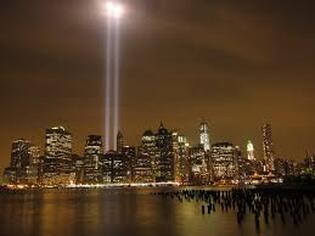
These year is the 25th time we will recite the names of those we lost. We have to acknowledge that non of the students in our k-12 schools were not alive, yet the consequences of those reverberate through their live in a variety of ways. In politics, in immigration policies. and in armed conflicts, just to mention a few. Of course, we must consider the lives of people who lost family and friends.

This year we are reposting what Lesley wrote five years ago. This post marks the event by reviewing books and collecting some comments by YA authors who have written about that fateful day.
Picture

20 MG/YA Novels to Commemorate the 20th Anniversary of 9/11
​(+1 Graphics Collection)
by Lesley Roessing

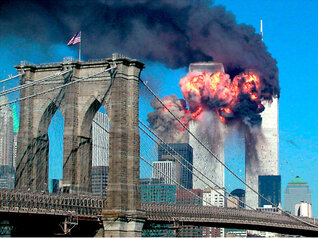
No historical event may be as unique and complicated to discuss and teach as the events of September 11, 2001, the day terrorists crashed planes into, and destroyed, the Twin Towers of the World Trade Center. At the time of this event no child in our present K-12 educational system was yet born, but, in most cases, their parents and educators would have been old enough to have some knowledge of, and even personal experience with, these events, making this a very difficult historic event for many to teach. However, with the devastation and impact of these events on our past, present, and future and as ingrained a part of history these events are, they need to be discussed and understood as much as possible.
 
On this  20th anniversary (now the 25th), the incidents of September 11, 2001 are still vivid in the minds and hearts of those who experienced and were able to comprehend these events. Many of our students have still not learned about the events, and many others do not realize the impact of those events on their world. One of the most effective ways to learn about any historical event, and the distinctions and effects of that event, is through a novel study—the power of story. 
I have found the most effective way to confront difficult topics while still presenting a variety of perspectives and differentiated reading experiences for our diverse readers is through reading in book clubs. It has been eye-opening—and rewarding—to visit schools and facilitate book clubs using novels written about the events of 9/11 from differing perspectives. When classes read 5-6 novels about 9/11 in small groups of students who are collaboratively reading, they can access differing perspectives to a story and generate important conversations within each book club and between book clubs. Book clubs gives readers safe spaces to discuss sensitive topics and their own feelings. A complete unit on this topic for English-Language Arts and Social Studies classes is outlined—with daily focus lessons and student examples—in chapter 10 of Talking Texts: A Teachers’ Guide to Book Clubs across the Curriculum
Picture
I have previously written three guest blogs for YA Wednesday on novels set around 9/11 and decided on this anniversary to interview some of the authors of these important and necessary novels which should be in every community and school library and grade 4-12 ELA and social studies classroom libraries.
 
I asked some of the authors three questions, requesting that they choose one to answer. I share their fascinating answers.
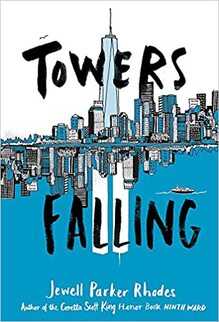
  • Jewell Parker Rhodes, author of Towers Falling
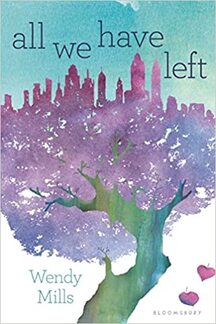
  • Wendy Mills, author of All We Have Left
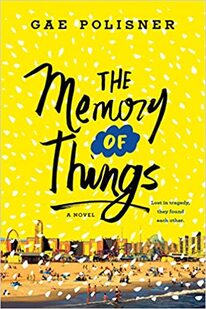
  • Gae Polisner, author of In Memory of Things
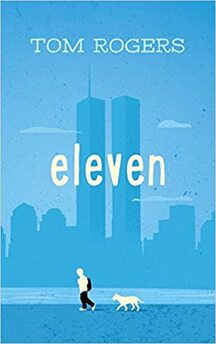
  • Tom Rogers, author of Eleven
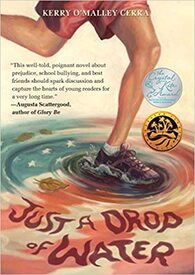
  • ​Kerry O’Malley Cerra, author of Just a Drop of Water
  • ​Nora Raleigh Baskin, author of Nine, Ten: A September 11 Story
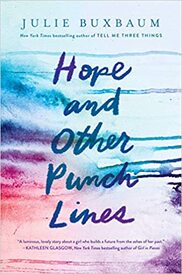
  • Julie Buxbaum, author of Hope and Other Punchlines
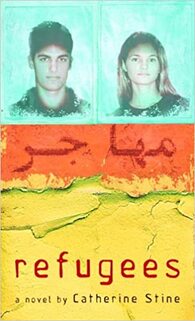
  • Catherine Stine, author of Refugees​

1. How/Why did you decide to write a novel about the effect of 9/11

Picture
​Tom Rogers, author of Eleven:
​

Most story ideas emerge over time, but I can pinpoint the birth of Eleven to September 11, 2008. My nephew was visiting us in California and asked, "Uncle T, what's the big deal about 9/11?" His question shocked me at first, but a bit of digging revealed that schools weren't teaching about it; the topic was too fraught, and there were almost no books for kids to help tell the story of that awful day. Ironically, my nephew had just interviewed an older friend of mine, a Holocaust survivor who speaks to schoolkids about his experience so that humanity will never forget. I realized we need to be telling the story of 9/11 to future generations so that we, too, will always remember how the world changed that day. 

Picture
Gae Polisner, author of The Memory of Things:
​

After 9/11, and pretty much for the first time in my life, I was having a hard time coping. I had young children at home and suddenly didn't feel our world or country was safe for them anymore. Of course, in my earliest childhood, I was raised against a backdrop of, and always well aware of, war as my father was a young M.A.S.H. surgeon in Viet Nam, gone for a whole year. But beyond that, my childhood had felt safe and our country was in a peaceful and prosperous period where it -- we -- all felt pretty invincible. Until 9/11.
​
For weeks after, then months, that stretched closer to a year, I felt scared and off balance. Living under an hour from my beloved NYC (where I had lived pre-children), I didn't want to go in, ride over the bridges, visit landmarks I had loved. I was searching for ways to cope, and my brain started telling me to write about it. Write it out in story, with characters who are resilient and figure out how to rise against the immediate backdrop of destruction and despair. And so were born Kyle and the bird girl. Only typing this answer now does the "bird rising" connection even come to me. 

2. How did you decide on the perspective your novel presents or the characters/setting you created to tell the story of the effects of 9/11?

Picture
​Wendy Mills, author of All We Have Left:
​

The primary emotion we associate with 9/11 is grief  and anger, but when I decided to write this story, I knew I wanted to shine a light on the incredible bravery and strength of the  people trapped in the Towers, as well as the families dealing with the loss of their loved ones. I thought it was important to remember that on one the darkest days of human history that there were still these bright moments of light, of humanity. Alia’s story showed us the extraordinary courage of ordinary people that day, and I chose Jesse and her family, fifteen years after the events,  to symbolize one family’s journey from grief and anger to ultimately a place of acceptance and forgiveness.
​
I wanted to write a story that showed how important that day was to our country, but also to show the strength of the human spirit in the face of tragedy.

Picture
​Jewell Parker Rhodes, author of Towers Falling:
​

I love fifth graders! Selecting three fifth grade characters was an intentional choice.  In eight years, they will be old enough to vote and defend our country.  They need to know America’s history, past and recent.  Because adults are traumatized by 9/11 memories, we have steered conversations away from this pain.  But we need to be strong and engage children. Essentially, all youth born post-9/11 are, nonetheless, experiencing its’ traumatic legacy. 
In Towers Falling, Deja, an African American, experiences homelessness because her father, a survivor, has psychological trauma and is unable to work.  Her family, too, represents how mental health and medical bills are the leading cause of homelessness.  Her friend, Ben, is Jewish American and a New York transplant from Arizona, because his parents are divorcing. His father’s repeated deployments and PTSD has fractured his family but not his empathy for his friends.  Sabeen, a Muslim-American, represents how post 9/11, religious prejudice and the scapegoating of Muslim Americans as terrorists, continues. 
​
Sabeen, Ben, and Deja with their open hearts and curiosity embody the foundational American values of immigration, religious tolerance, and “liberty and justice for all.”

Picture
​Kerry O’Malley Cerra, author of Just a Drop of Water:
​

In September of 2001, I, along with the rest of the world, watched in horror as the attacks on New York City, The Pentagon, and in the sky over a tiny Pennsylvania town unfolded; yet as heart-wrenching as it was to watch on TV—I was glued to my TV for days—I was also swept up with the sense of patriotism that swelled deep for months after. Everywhere I turned, red, white, and blue saluted people across town from t-shirts, to pins on our lapels, to flags boasting in the sky. Neighbors–who usually came home, pulled into their garages, and closed their doors–suddenly stopped in their front yards to talk. People came together in ways I’d never experienced before.

Within a day or two of the attacks, my alternating moods of anger, sadness, and pride suddenly had a new emotion to deal with. Fear. It was discovered that Mohammad Atta, the hijacker of American Airlines flight 11, lived just around the corner in my smallish town of Coral Springs, Florida—over 1,000 miles away from the closest attack. What if I’d seen him around? What if my family and I had eaten next to him at a restaurant? It stunned me to the core.

It didn’t take long for more of the details involving that day to emerge. It seemed Atta and several of the other hijackers had made their way around South Florida unassumingly for months. But when it leaked that these men had taken flight lessons in Venice, Florida, and it was believed they’d had help from fellow Muslims living there, hundreds of “what ifs” began to haunt me. Every single one of them boiled down to the final, What if my friend’s parents had helped these men?

My friend was someone I’d met in college. He had come to the U.S. to study and get away from the strict Islamic rules of his upbringing, if only for a while. We grew close, and eventually my sister, my boyfriend, and I went to visit his devout Islamic family abroad, where his parents welcomed us into their home and treated us like old friends. A few years later, wanting to be closer to both of their boys who were then living in Florida, the parents decided to move to the states—Venice, Florida to be exact.

Flash forward to the days following September 11, I found myself doubting my friend’s family when I’d heard they were being questioning in connection to the attacks. Had they helped these terrorists somewhere along the way? I’d love to say I believed they were innocent, but I’d be lying. It took me a day or two to really know in my heart that they weren’t involved. Not these loving, welcoming people. I hated myself for having ever wavered in my thoughts of them to begin with, but the emotion of that tragedy ran deep. The emotion and fear of those days controlled me.

Not long after, I talked to my friend and asked how he and his family were doing. He told me that the FBI had cleared his parents, but life had become difficult for all of them. I listened to him talk, and though I didn’t admit it to him then that I had doubted them myself, he knows now. So do his parents, and I cannot thank his father enough for reading several drafts of this book and helping me get it right.

The feeling of regret stuck with me for a long time. Being a teacher, I looked at kids around me who rarely saw racial lines, and I wondered if this boy—my college friend—and I had been younger when September 11 happened, would I have ever doubted his family? Would I have had the prejudice that seemed to come with age? I began asking questions to anyone who wanted to discuss the subject. Soon I was taking notes, scouring the Internet, and reading books; I was amazed to learn that many non-practicing Muslim kids in the United States actually turned to mosques for answers following 9/11. The basis for my story developed in my head before I even realized I was writing it.
​
As a former history teacher, this was a story I knew needed to be told. It’s the type of novel I myself would have used in a classroom to supplement the textbook and to show kids, who didn’t experience that day firsthand, the enormity of the event that happened on our own soil and took thousands of lives—six of them from my own small town, a thousand miles away. I want children to know that sentiments changed from minute to minute, teetering between patriotism, alarm, grief, and so much more. One of my favorite scenes in the book is the one where Jake and his dad attend a memorial service three days after 9/11. That event is real. It moved me the same way it moved Jake. I hope it moves you, too.

Picture
​​Nora Raleigh Baskin, author of Nine, Ten: A September 11 Story:
​

When I started writing Nine, Ten: A September 11 Story, I knew exactly how many characters there'd be, who they'd be, and in what setting I needed to place them. I even knew the title! I wanted to show how the events of 9/11 affected everyone, across the entire county.  I didn’t want to limit my story to New York City or to the day of the attacks. That is another story, another book, for another writer to tell. 

For my story, I deliberately chose characters spanning from California to New York, rural to urban, black to white, boy to girl, Jewish to Muslim to Christian. I wanted to make them as different as I could to reveal how similar they actually are—how similar WE actually are—and to show how this tragedy connected us all in ways both big and small.
​
 Of course I wanted to, and I could have tried to include more, but it is already a challenge for young readers (and writers!) to keep track of multiple characters. So I kept it to four. And since setting in a story also refers to time, my book begins 48 hours before September 11, 2001. I wanted to draw a line between the before and the after and show how the world changed that day.

First there is Will, a boy living in Shanksville, PA, the town where the fourth plane crashed after being diverted from its target (The Capitol building) because of the incredible heroism of the passengers on Flight 93. 

I also wrote about Sergio, a boy in Brooklyn, who that morning witnessed the Twin Towers collapsing in a mushroom cloud of black smoke and white ash. He has a friend and mentor who is an EMT, who I chose because I knew I could not address the events of 9/11 without honoring the bravery of the first responders, many of whom died that day and in the days and years that followed. 

I brought Aimee to life in California. Her mother had a meeting at the World Trade Center that morning and narrowly escaped death. I needed to speak about the beauty of life and how we sometimes, sadly, only fully realize that when it is almost lost. 

And lastly, there's Naheed, an Iranian Muslim girl in Columbus, Ohio, whom I very consciously gave a Persian ancestry in order to point out a specific kind of bigotry. Not all Muslims are Arab; not all Arabs are Muslims; and not all Middle Easterners are Arab or Muslim or Jewish. As we know, after 9/11 the rise of Islamophobia and xenophobia exploded and was often directed blindly at anyone of Middle Eastern descent. I needed to show how the fear of terrorism generated an increase in this discrimination, an anger that was spewed widely and with ignorance.
​
In my small way, I wanted to help young readers open their eyes and their minds. I wanted them to learn about a time in our history that many adults felt was too hard, too scary, too sad to talk about. Reading can bring empathy, understanding, and knowledge—at least that was my hope.

Julie Buxbaum, author of Hope and Other Punchlines:
​

I've long struggled with the moments that cleave our lives into a before and an after, and there seems to be few modern shared before and afters quite like 9/11. Although there are a gazillion political ramifications from that day, I tend to be more interested in the personal legacies of loss. How they shape us. How we continue to live despite knowing that the world can cleave at any time. How we risk loving and losing. How we laugh in spite of it all. 
​
Baby Hope, an entirely fictional character and photo, became the long lens that allowed me to look more deeply at those questions. She also allowed me to explore the myriad ways 9/11 still isn't over. As many as four hundred thousand people are still struggling with health conditions related to that terrible day. By framing my story with a modern teenage girl, I hoped to introduce the legacy of 9/11 to the generation born since 2001, for whom the event feels like ancient history. Unfortunately, it is not.

3. Twenty years after the events of September 11, 2001, how might  you change or add to your story?

Catherine Stine, author of Refugees:

​In the span of the seventeen years since my novel, Refugees was published, and a full twenty years since 9/11, life for Afghans has improved dramatically, and yet this fascinating country is also stubbornly resistant to change for reasons that I was able to profile in the book. It may have a centralized government on paper, but its localized, tribal structure holds firm. Its poppy trade is almost impossible to eradicate, as it is a huge money source, which keeps the Taliban in power. It seems likely that the Afghan army will still buckle under the Taliban. This will also set women’s rights back, but hopefully, they will not lose all hard-fought ground. Pakistan’s badgering influence still holds. There’s the infernal question of whether the USA should be a peacekeeping force to the world, or whether it’s really time to pack up and leave. These questions have no easy answers.
​
My intention with Refugees, was to present, through the personal lens of Johar, an Afghan boy and Bija, his little cousin, the day-to-day life, and the danger after 9/11 that also existed for those in Afghanistan. My extensive research taught me about their ancient culture, the intricacies of their tribal networks, and the stark beauty of the people. This information is relevant after all this time. Perhaps if I changed anything, it would be to hint that this was a snapshot in time, and that history often has circular cycles.
Picture
Gae Polisner, author of In Memory of Things:
​

I'm glad I wrote The Memory of Things when I did versus now as it would definitely have to be more political— and more divided—now. I'm always hoping young readers will see how, at that time, in the face of tragedy, we found our shared humanity much more readily and rallied together, human to human, without regard for politics.

Of course, that was on a whole, but there were splinters of misinformation and hate that arose from the event as well, and were, in fact, the spark of one form of ongoing hate in our country, and our stories deal with that . . . in The Memory of Things in particular, a moving moment when the kids head out of the subway on Stillwell Avenue on their way to Coney Island in the days after and pass heavily gated stores bearing Arabic names and signs that plead for us all to remember that they, too, are "[f]irst Americans." That was based on a sign I saw in a photograph during the research phase of my book, and if there's one thing readers take from my story after a simple sense of hope, it is that: our shared humanity.

The 20 Novels

​The 20 novels reviewed in this blog each present a different perceptive on these events, whether from the view of an 11-year-old boy waiting for his father’s return from a job that takes him into the Twin Towers, a 16-year-old whose family was torn apart 15 years before when her teenage brother died in  the Towers, a Muslim family facing racism on the days following 9/11, an adolescent coping with the possible physical effects of 9/11 syndrome after being rescued from her day care in the World Trade Center complex, fifth graders learning about events from 15 years before, or survivors from the March 11, 2011 Japanese tsunami visiting NYC to meet with survivors of September 11,2001. The stories are set in in a variety of settings, not only New York City, but Brooklyn, Chicago, Los Angeles, Shanksville, Florida, Japan, Pakistan, and Maine. These novels portray challenges, difficult decisions, loss, grief, uncertainty, PTSD, discovery, resilience, and heroism and are written in prose, free verse, and as a play for readers in a range of ages, reading levels, and interests.
 
                                                                           *                      *                      *
Picture
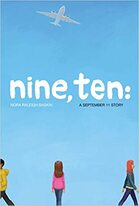
1. ​Baskin, Nora Raleigh. Nine, Ten: A September 11 Story. Atheneum Books for Young Readers, 2016. 

The events of 9/11 are challenging to describe and discuss, especially with children who were not yet born, which at this point is most of our student population. I think that is so because, as adults, we each have our memories of that day and Life Before. I was a middle school teacher on the day the Towers fell. I remember standing in my classroom as our team teachers watched the morning news. Thankfully, our students were in their Specials and were not witness to the shock and tears on our faces. I don’t remember much of that day, but we were located in Philadelphia and did not immediately feel the effects. But the events o that day have affected our country and all our citizens as well as our contemporary world. The importance of studying and discussing 9/11 as part of American history is highlighted in Jewell Parker Rhoads novel Towers Falling, set in September, 2016.

Nine Ten: A September 11 Story is another novel effective in introducing young adolescent students to the many events of September 11, 2001. Nora Raleigh Baskin’s novel is set during the days leading up to 9/11—in Brooklyn, Los Angeles, Columbus, and Shanksvlle, Pennsylvania, where readers follow four diverse middle-grade students affected by the events of 9/11. Sergio, Naheed, Aimee, and Will first cross paths in the O’Hare Airport on September 9. The four young adolescents are Black, White, Jewish, and Muslim and are collectively surviving loss, guilt, poverty, parental absence, neglectful fathers, bullying, the navigation of peer relationships, as well as the angst of middle school, “…everything felt different, as if you suddenly realized you had been coming to school in your pajamas and you had to figure out a way to hide this fact before anyone else noticed.” (p. 48). In their own ways they are each affected by 9/11, and on September 11, 2002, these four and their families again converge at Ground Zero, each there for different reasons, but this time their paths back together have meaning.
 
There are a multitude of important conversations to be generated by this little novel, a story of Before and After. I was especially grateful that the events and heroes of Shanksville were memorialized. In fact there are many aspects of heroism brought forth in the novel to discuss. But Nine, Ten: A September 11 Story is the story of people and three days in their lives, “Because in the end it was just about people…Because the world changed that day, slowly and then all at once.” (p. 176).
Picture
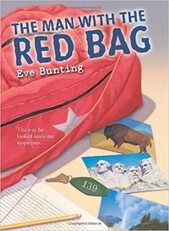
2. Bunting, Eve. The Man with the Red Bag. Joanna Cotler Books, 2007.
 
“We don’t trust anymore, and that’s the saddest thing of all.’” (116)
 
Eve Bunting’s chapter book is not about the events of September 11, 2001, but it is about the effects and repercussions that we are still experiencing from 9/11.
 
Kevin Saunders and his grandmother go on a bus trip out West and immediately notice a fellow traveler, Charles Stavros, a man who says he is Greek but raised in America. A man who Kevin thinks looks like “…he might be Saudi Arabian or even Iraqian, if there is such a word. He was dark skinned, with bushy black eyebrows and a bushier mustache.” (2) And a man who constantly carries a red bag which he refuses to put down, even on a rafting trip.
 
Some of the other passengers worry that he is a terrorist and that his face looks familiar. As Kevin’s Grandma says, “It’s sad. People are quick to jump to conclusions now. If someone looks like that—” (10)
 
Kevin, a voracious reader of Joan Lowery Nixon mystery novels and his “much-read how-to-write-a-mystery book and is convinced that Stavros is a terrorist, is anxious to solve the mystery of the red bag which he is sure is holding a bomb. His elicits the help of the other young passenger, Geneva, who also wants to be a hero and appear on the Oprah show. Geneva’s eyes opened wide. ‘He does look exactly like a terrorist. I’ve never seen a real one, but I’ve seen pictures on TV.’” (39)
 
As they follow Stavros, even keeping watch on his various hotel rooms all night, they become more and more convinced that he is going to bomb an American monument, possibly Mount Rushmore, and that they can save the day. And then Kevin can write the mystery. “I didn’t want him to be Greek. I didn’t want him to be innocent. I didn’t want to lose my big mystery adventure. But just think how scary it would be if he wasn’t Greek. If he was something else! Having a mystery also meant having a terrorist aboard. And a bomb. Criminy! What did I want?” (60)
 
What they find ties Stavros to 9/11, but not in the way they think.
 
This is yet another perspective of the events and effects of September 11, 2001, appropriate for grade 4-8 readers. 
Picture
3. ​Buxbaum, Julie Hope and Other Punch Lines. Delacorte Press, 2019.

For many people the world is divided into Before and After, the dividing line being September 11, 2001. Such is the case for Abbi Hope Goldstein and Noah Stern.

On her first birthday Abbi was saved by a worker in her World Trade Center complex daycare center. As she is carried out, wearing a crown and holding a red balloon, the South Tower collapsing behind, a photographer takes the picture that has branded her Baby Hope, the symbol of resilience. Abbi spends her childhood and adolescence in relative fame; strangers hug and cry, share their stories with her, frame and hang the photograph in their homes, and news outlets hold “Where is Baby Hope Now” stories.

Noah was a baby in the hospital, fighting for his life, on 9/11 when his father went back to his office in the World Trade Center for his lucky hat, never to return home. He and his mother now live with her new husband and Noah is obsessed with comedy.

At age 15, Abbi is experiencing a suspicious cough, keeping it a secret from her parents and grandmother. Connie, the daycare worker, has recently died from cancer, most likely 9/11 syndrome, and Abbi takes a job as a camp counselor in a nearby town, looking for some anonymity and a chance at a “happily ever after” to the story that began with “Once upon a time” (9/11). Unfortunately, Noah, a fellow counselor, recognizes her and blackmails her into helping him interview the four other people in the iconic Baby Hope picture, convinced that the man in background wearing a Michigan cap is his father and also convinced, since his mother won’t talk about him, that his father chose not to come home after escaping from the Tower.

This is a novel about 9/11, one that presents yet more facets than many other 9/11 novels, such as 9/11 syndrome which is affecting many of those who were at Ground Zero, heroism and sacrifice, survivor guilt, and “[What] happens when the story you tell yourself turns out not to be your story at all.” (280)
​
This is primarily a novel about relationships—shifting relationships with family, friends, ex-friends, strangers, and romantic partners. I absolutely adored these characters—Noah and Abbi especially (and their evolving relationship) and Noah’s BFF Jack, Abbi’s divorced-but-best-friends-and-maybe-more parents, her grandmother who is experiencing the onset of dementia, and even Noah’s stepfather who learns to make jokes. I was sorry when the novel ended, not that the story was unfinished but my relationship with the characters was.
Picture
4. Cerra, Kerry O’Malley.  Just a Drop of Water. Sky Pony Press, 2016. (Middle Grades)
 
Relationships are built over time, but how much can they withstand? Jake Green and Sameed Madina have always been friends. They have grown up together; they run track together; they play war games together; they have each other backs; they plan to always remain friends “but only till Martians invade the earth.”

But then the events of September 11, 2001, occurred, and Martians did invade the earth, only they looked like Sam and his family—Muslim. Because one of the terrorists had lived in their neighborhood and was a client at the bank where Mr. Madina worked, Sam’s father comes under FBI surveillance, and the neighborhood divides in their support. Not Jake, though. He believes in his friend and his friend’s family, physically fighting the school bully who refers to Sam as a “towelhead” and arguing with his own mother whose own grief keeps her from supporting their neighbors.

When his father is taken into custody, Sam refuses to attend school, abandons his cross-country team, and distances himself from Jake, taking a new interest in the Islam religion. But Jake does not give up, and the boys reconnect to peacefully stop their racist classmates, Bobby and Rigo, from attacking the local mosque. Afterwards, Jake realizes that they both have been affected by 9/11; he has learned that you can be both scared and brave at the same time, but he has also has learned that adversity can be defeated peacefully. And Jake realizes that Sam is now different. “For the first time I see Sam, a Muslim. An American Muslim. But he is still just Sam, no matter what.”
Picture
5. Donwerth-Chikamatsu, Annie. Somewhere Among by Annie Atheneum Books for Young Readers, 2016. 

Ema is binational, bicultural, bilingual, and biracial. Some people consider her “half,” and others consider her “double.” Her American mother says she contains “multitudes,” but Ema sometimes feels alone living in Japan somewhere among multitudes of people. 
​
When fifth-grader Ema and her mother go to live with Ema’s very traditional Japanese grandparents during a difficult pregnancy, author Annie Donwerth-Chikamatsu’s verse novel takes the reader through six months (June 21, 2001-January 2, 2002) of customs, rituals, and holidays, both Japanese and American. There are challenges, such a choosing a name for the new baby that brings good luck in Japan and that both sets of grandparents can pronounce. Ema celebrates American Independence Day and Japanese Sea Day, and she now views some days, such as August 15 Victory Over Japan Day from diverse perspectives.
 
On September 11, 2001 Ema experiences both two typhoons in her town and the attacks on the World Trade Center and the Pentagon in America—on television. As the reader traverses the intricacies of two fusing two distinct cultures with Emi and her family, our knowledge of others is doubled.
Picture
6. DuBois, Caroline Brooks. The Places We Sleep. Holiday House, 2020.
 
2001:
“the year we moved to Tennessee,
the year of the terrorist attacks,
the year my period arrived,
the year Aunt Rose died,
and the year Dad left for Afghanistan.” (166)
 
Twelve year old Abbey is, as the boys in her new school call her, an Army brat. She has moved eight times, but this time she is not living on base with others like her. This time she attends a school where there is only one other new girl, Jiman, a Muslim-American of Kurdish heritage, born and raised in New Jersey.
 
Abbey is shy, uncertain, voiceless,
“I worry about people speaking to me
And worry just the same
When they don’t.” (27)
 
“Here’s what I’m used to being:
            the last to be picked,
            that girl over there,
            the one hiding behind her hair
            counted absent when present,
            the one who eats alone,
            sits alone,
the quiet type,
a sit-on-the-sidelines type,
the girl who draws,
 
and lately
‘Army brat.’” (107-8)
 
 
Luckily over the summer before school began, she made a new best friend, Camille, who is athletic and confident and has no trouble standing up to bullying.
 
As Abbey deals with her new school and the taunts of the other 7th graders and the boys on the school bus, the Twin Towers are hit and Abbey’s Aunt Rose is missing from her office on the 86th floor of the World Trade Center.
“Was she aware,
                        Unaware,
                                    Have time to prepare…
Have time to think, to blink,
Time to wish, to wonder,
Did someone help her,
Was she alone,
Did she whisper a prayer,…” (24)
 
During this year Abbey contends with her periods, her missing aunt, her mother’s temporary absence to New York to take care of Aunt Rose’s husband and children, the “Trio” of Henley Middle ( the popular Mean girls), the eventual deployment of her father,  and, on a positive note, the attentions of Jacob—Camille’s other best friend. Abbey also notices how people are treating Jiman who remains confident, appears comfortable alone, and stands up when her little brother is harassed, but has no one championing her. At times Abbey feels she should speak up on behalf of Jiman, but she continues to keep quiet, losing herself in her art.
            “What I don’t do
            is tell them to shut up,
            to leave people alone for once
because mostly I’m relieved
that they’ve forgotten
about me. “(120)
 
Through art, Abbey finally gets to know Jiman and gains strength from her, strength to become an upstander rather than a bystander. With Camille, Jacob, and Jiman as friends, Abbey realizes,
            “Sometimes it takes an eternity to figure things out,
            Especially when you’re in middle school.” (245)
 
Caroline Brooks DuBois’ debut novel written in free verse and formatted creatively on the pages is a coming-of-age novel, a novel of fitting in, gaining confidence, showing tolerance  and kindness towards others and standing up—for oneself and others. 
Picture
7. Gratz, Alan. Ground Zero. Scholastic Press, 2021.
 
Two children 18 years apart, both at the mercy of terrorists, both in death-defying situations, both fighting for their lives, and both showing courage and compassion for others as they live with grief. At one point they are both at their own Ground Zero.
 
Nine-year-old Brandon goes to work with his father at the Windows on the World restaurant on the 107th floor of the North Tower. The date is September 11, 2001. He leaves his father to go down to the Mall to buy something for a friend, and while he is descending in an elevator, the first plane hits the Tower. As Brandon tries to make his way up to his dad and then, when that is impossible, back down to fulfill his father’s wishes, “Brandon, hang up [the phone] and get out of the building as fast as you can.” (158) and “You’re strong. You can survive without me.” (234), he meets Richard who takes him under his wing. “It didn’t feel weird at all to Brandon to be clinging to a stranger right now. It was reassuring to connect with someone else who was sharing the struggle to survive.” (104) Together, on the way down, Brandon witnesses every horror—elevators filled with people crashing, workers falling and jumping out of the building to their deaths, people catching on fire—but the people he and Richard meet collaborate to help each other until finally Brandon makes it to safety and is able to save Richard when the Tower collapses.
 
Meanwhile on September 11, 2019, Reshmina, an 11-year-old Afghani, lives with her family in a small village in the middle of constant fighting between the Americans and the Afghan National Army and the Taliban. Her sister had been accidentally killed by American soldiers on Hila’s wedding day “We’re fighting a war again the Taliban. Sometimes innocent people get hurt.” (246). When an American soldier is hurt, with conflicting emotions, Reshmina hides him in her house, she puts her family and her village in grave danger. Her resentful twin Pasoon leaves home to join the Taliban and to tell them about the soldier. In danger Reshmina and her family leave to hide in a cave. “She had chosen what was right over what was easy. She had dared to be someone new, someone better, to carve a path for herself. And look where it had gotten her; buried with her family in a grave of her own making.” (245) After Reshmina’s ingenuity helps her family and the villagers to successfully escape the collapsed cave, the American soldiers sweep in to rescue Taz and order a strike against the Taliban. Again accidently, the houses in the village are all wiped out. “When they were all safe, they all turned and watched as the village slid down into nothing, swallowed by the great brown cloud of dust that came roaring at them like a lion.” (282) “‘That was not supposed to happen.’ ‘And yet it did,’ Reshmina said.” (283)
 
When Brandon’s and Reshmina’s stories converge, readers learn just how complicated is the present American military involvement in Afghanistan and the ongoing impact of revenge.
Picture
8. Levithan, David. Love is the Higher Law. Random House Children’s Books, 2009.
 
“…even if I felt something was wrong, I would never have pictured this. This isn’t even something I’ve feared, because I never knew it was a possibility/” (5) “’We are not supposed to comprehend something like this,’ my mother says to me…. I don’t want to comprehend. Instead, I will try to remember what matters.” (16)
 
The attacks of September 11, 2001, affected our country as a whole, but it is even harder to imagine the effect on those who lived in NYC. Claire, Peter, and Jasper are three teenagers living in NYC on that date. Claire leaves her high school to pick up her brother from his elementary school; Peter has already left school and is at the record store, thinking about his impending date with Jasper; and Jasper is at home alone, his parents visiting their native Korea, before he leaves for college. None of the three are directly affected—none of their parents worked in the World Trade Center, none of their friends or relatives were killed; they were not physically hurt—but the events of this day color the year following. “I want to know why this is so much a part of me.  I want to know why this thing that happened to other people has happened so much to me.” (104)
 
Readers view the day through their alternating perspectives. We view the constructive acts of strangers as Claire observes,  “There are skyscrapers collapsing behind us, and nobody is pushing, nobody is yelling. When people see we’re a school group, they’re careful not to separate us. Stores are not only giving away sneakers, but some are handing out water to people who need it. You’d think they’d take advantage and raise the prices. But no. That’s not what happens.” (14) and Peter reflects,  “And the people I care about, suddenly I care about them a little more, in this existential way.” (82)
 
Even though Peter and Jason’s date does not go well, another ramification of the day, the three become friends, especially Claire and Peter who attend high school together, Jason returning to college. And the year continues, each is a little changed. As Peter observes, “ If you start the day reading the obituaries, you live your day a little differently.” (123)
 
By December Jasper observes that he has finally gone an entire day without thinking of 9/11 but then wonders what that means. Claire feels the weight of the day lighten a little, but “It is still strange to see the skyline. I have never seen an absence that it so physical.” (126)
 
On the anniversary of 9/11 Claire retraces the steps she took on that day, and Peter and Jason finally have a second date. On March 19, 2003, the day of the United States invasion of Iraq, the three reunite, and Claire observes, “And we are so different from who we were on September 10th.  And also different from who we were on the 11th. And the 12th. And yesterday.” (163) Together they have found the “antidote” to the fear and uncertainty; they have each other as they individually navigate the world and remember what matters.
Picture
9. Lowitz, Leza. Up from the Sea. Ember, 2016.
 
“The bigger the issue, the smaller you write.”--Richard Price
Instead of focusing on the overwhelming statistics generated by the March 11, 2011 earthquake and resulting tsunami in Japan—nearly 16,000 deaths and 3,000 people missing—the event becomes even more intense and compelling as author Leza Lowitz relates the story of one town and one boy and the resilience of many.

The story begins on March 11 when Kai, a half Japanese, half American 17-year-old and his teachers and classmates experience the “jolting of the earth,” and as trained, they evacuate, running for their lives, looking for the highest place, as their town is destroyed. Written powerfully in free verse, the reader feels the fury of nature as the water “churns,” “thrashes,” “surges,” “sweeps,” “charges.” Kai ends up in a shelter having lost his mother, his grandparents, and one of his best friends. His father left years before to return to America.

Faced with overwhelming loss and trauma, Kai walks into the ocean but is saved by one of his classmates and convinced to accept the opportunity to go to New York City on the tenth anniversary of 9/11 where he will spend some time with young adults who lost their parents as teens in the 9/11 attacks. At Ground Zero, Fia tells him, “Bravery means being scared and going forward anyway.”

Kai hopes to find his father in NYC but returns to his village to help the young adolescents who lost their families and to rebuild his town. “I want to be/ like that tree/ deep roots/ making it strong/ keeping it/ standing tall.” And it is to his roots Kai returns and stays—“The quake moved the earth/ ten inches/ on its axis./ I guess/I shifted,” too.”


Up from the Sea, well-written as a verse novel (a format that engages many reluctant readers), would serve as an effective continuation to a 9/11 study. Readers should already be aware of the events of 9/11 to understand the connection between Kai and Tom but will comprehend the trauma and loss experienced, and resilience that is required, by anyone who faces adversity.
Picture
10. Maynard, Joyce. The Usual Rules. St. Martin’s Press, 2004.
 
The Usual Rules is an emotional and insightful novel about the effects of the events of September 11th on the families and friends of the victims—those left behind.
The reader learns about the close relationship between 13-year-old Wendy and her mother through flashbacks: her mother's divorce, the sporadic visits of her father, her mother's marriage to her "other dad," and the birth of her half-brother. And then her mother goes to work at her job at the World Trade Center on 9/11/2001—and does not return. Wendy’s world changes. “Then September happened and the planet she lived on had seemed more like a meteor, spinning and falling” (p. 175).

The reader experiences not only Wendy's (and Josh's and Louie's) loss but the suffering and uncertainty of those left behind. Could her mother be walking around, not remembering who she is? As the family hangs signs, we learn how different this loss was for many people who held out hope for a long time without a sense of closure. And this loss was different because it was experienced by many—an entire country in a way. “Instead of just dealing with your own heart getting ripped into pieces, wherever you looked you knew there were other people dealing with the same thing. You couldn’t even be alone with it” (p. 95).

We see the loss through the eyes and hearts of a daughter, a very young son, and a desperately-in-love husband. Wendy leaves Brooklyn and goes to her biological father’s in California. Among strangers, she re-invents her life. As those she meets help fill the hole in her life, she fills the hole in theirs. Books also help her to heal.

Even though there are quite a few characters in this novel, but they all are well-developed, and I found myself becoming involved in all their lives, not only Wendy, Josh, and Louie and even his father Garrett, but Wendy’s new friends—Carolyn, Alan, Todd, Violet… On some level they all have experienced trauma and loss, and within these relationships, Wendy is able to heal and return to rebuild her family.

Although I did not want this novel to end and to leave these characters, this well-written novel taught me more about the effects of September 11, loss, and the importance of relationships and added a new perspective to my collection of 9/11 novels.
Picture
11. Mills, Wendy. All We Have Left.  Bloomsbury, 2016.
 
September 11. A day that changed all our lives in some way. As we see in Nine, Ten: A September 21 Story, there clearly was a Before and After. But there also was a Then or That Day and an After.

All We Have Left was so compelling that I read from dawn to dusk and did not put the book down until I finished. The novel intertwines two stories, that of 18-year-old Travis and sixteen-year-old Alia who were in the Towers as they fell and the story of Travis’ sister, Jesse, who, fifteen years later, is part of a dysfunctional family whose lives are still overwhelmingly affected by That Day and Travis’ death.

Seventeen year old Jesse is not sure who she is, who she should be, who she should hate, and who she can love. Her life is overshadowed by 9/11, her mother’s mourning, and her father’s hate.

But both Alia in 2001, and Jesse in 2016, learn that “Faith and strength aren’t something that you wear like some sort of costume; they come from inside you” (p.329) as does love. And Jesse realizes that she has to work on “treasuring right here, right now, because that’s important.” As one character says but all the characters learn, “You can fill that void inside you with anger, or you can fill it with the love for the ones who remain beside you, with hope for the future.”

What I appreciated about this novel is that is shows yet another side of how 9/11 affected people, especially adolescents, those adolescents who populate American schools everywhere. I strongly feel that students should not only be learning about the events and effects of 9/11, but that, through novels, readers learn more about how events affect people and especially children their ages. 
Picture
12. Padian, Maria. Out of Nowhere. Knopf Books for Young Readers, 2013.
 
Another novel as a complement to a 9/11 Novel Study would be Maria Padian’s novel about the ways life in an idyllic small Maine town quickly gets turned upside down after the events of 9/11.
 
“Things get a little more complicated when you know somebody’s story.…It’s hard to fear someone, or be cruel to them, when you know their story.”

The majority of the 21.3 million refugees worldwide in 2016 were from Syria, Afghanistan and Somalia. The United States resettled 84,994 refugees. Together with immigrants, refugee children make up one in five children in the U.S. More than half the Syrian refugees who were resettled in the U.S. between October 2010 and November 2015 are under the age of 20.
.
In Out of Nowhere narrator Tom Bouchard is a high school senior. He is a soccer player, top of his class academically, and well-liked. He lives in Maine in a town that has become a secondary migration location for Somali refugees. These Somali students are trying to navigate high school without many benefits, including the English language. They face hostility from many of their fellow classmates and the townspeople, including the mayor; one teacher, at the request of students, permits only English to be spoken in her classroom.
 
When four Somali boys join the soccer team, turning it into a winning team, and when he is forced to complete volunteer hours at the K Street Center where he tutors a young Somali boy and works with a female Somali classmate, Tom learns at least a part of their stories. Tom fights bigotry, especially that of his girlfriend—now ex-girlfriend, but he still doesn’t comprehend the complexity of the beliefs, customs, and traditions of his new friends, and his actions have negative consequences for all involved. While trying to defend the truth, Tom learns a valuable lesson, “Truth is a difficult word. One person’s truth is another person’s falsehood. People believe what appears to be true and what they feel is true.”
Picture
13. Polisner, Gae. The Memory of Things. St. Martin’s Griffin, 2016.
 
The first 9/11 novel I read, The Memory of Things is lovely story about the effects of the events of 9/11. Another reason we read is to understand events we have not experienced and the effect of those events on others who may be like ourselves. After witnessing the fall of the first Twin Towers on 9-11 and evacuating his school, teenager Kyle Donahue, a student at Stuyvesant High School, discovers a girl who is covered in ash on the Brooklyn Bridge; she has no memory of who she is. The son of a detective, he takes her home to help her rediscover who she is, why she was where she was, what she was doing there, and her connection to the events.
 
Author Gae Polisner wrote The Memory of Things in alternating narratives—Kyle's in prose, the girl writes in free verse—the two characters sharing their stories and perspectives, introducing adolescent readers, many of whom had were not alive during 9/11, to the effects of this tragedy in their own ways.
Picture
14. Rhodes, Jewell Parker. Towers Falling.  Little, Brown and Company, 2016. 
 
I was a middle-school teacher in 2001. It was challenging to know how to discuss the events of 9/11 as we lived through them. How is a teacher to meaningfully discuss this momentous event with students who were not even born in 2001? Falling Towers is a thoughtful, provocative, well-written, albeit emotional, novel about this topic written sensitively and appropriately for readers as young as Grade 4, an ideal novel for middle grades Social Studies classes as it focuses on not only the history of 9/11 and its place in American history but the ever-widening circles of relationships among, and connections between, Americans beginning with families, friends, schools, communities, cities, states, countries.
 
The 5th grade characters explore “What does it mean to be an American?” as well as why history is relevant, alive, and, especially, personal as three students—one Black, one White, one Muslim—explore the effects of the events of 9/11 on each of their families. Déja’s “journey of discovery” about the falling of the Towers helps her father work through his connection to the event and his resulting PTSD.
Picture
15. Rogers, Tom. Eleven. Alto Nido Press, 2014.  
 
“After today, everything’s changed.”
“Sometimes when a terrible thing happens, it can make a beautiful thing seem even more precious.”

Eleven is the story of Alex who is turning 11 on September 11, 2001. I was concerned that the character would be too young for this topic. I also thought that, the character age’s implied that the novel wouldn’t contain the complexity the topic deserves. but, boy, was I wrong! I was hooked with the complexity of the first 2-page chapter. I wasn’t sure what was happening in this introductory chapter, but it was not a feeling of confusion as much as “It could be this; no, it could be this…” and inference and interpretation, even visualization.

I also forgot that New York City kids grow up faster, taking public transportation throughout the city, but more importantly, I forgot that when you need or expect a young adolescent to rise to the occasion, he will.

Alex loves airplanes and dogs—and he doesn’t realize it, but he loves his little sister Nunu who is relegated to her side of the bedroom they share by a black and yellow “flight line” down the middle of the room. And he loves his father, even though Alex told him, “I hate you,” the night before 9/11. When the Towers fall, Alex rises to the occasion, taking care of his little sister and an abandoned dog, making the sacrifice to return the dog he has always wanted to his owners when the vet finds a chip, facing bullies, making “deals” in the hopes these deals and good works will offset what he said to his father and ascertain his return from the Towers, and comforting Mac, a lonely man who is awaiting his only son’s return from the Towers.

In Eleven author Tom Rogers builds a character who is authentic, a kid who events serve to turn into a young man. Alex’s mother had said to him, “I need you to be grown up today” and, even though he was focusing on his misdeeds of the day, he did. “I’m proud of you, young man…. Young Man. Alex liked how that sounded.”

This book is not graphic but does not skirt the events. Readers hear the news announcement about the four airplanes and, more chilling, a description of an empty hospital—“There were no gurneys rolling through to the ER, no sick and wounded in pain. There wasn’t a patient in sight. And he knew then that none would be coming.” A powerful examination of the events of 9/11 and how they affected ordinary people—and one boy’s birthday.
Picture
16. Stine, Catherine. Refugees. Delacorte Books for Young Readers, 2005.
 
Refugees adds another dimension to the 9/11 novels.

Dawn is a foster teen who runs away to New York City and becomes affected by the events of 9/11. As she plays her flute on the streets near Ground Zero to earn money for food, she is approached by families of victims who ask her to play for them and the memories of their loved ones. As Dawn comes to believe this is her mission, she teaches herself music she feels appropriate for those of many cultures and stages of life. In doing so, she opens up to strangers and new friends, something she couldn't do with her foster mother.

Johar is an Afghani teenager, weaver, and poet. His father is killed by the Taliban, his mother is killed by a land mine, his older brother joins the Taliban, and his aunt is missing, leaving Johar to care for his three-year-old cousin. He and his cousin flee to a refugee camp in Pakistan where he works for the Red Cross doctor, Dawn's foster mother, another person who must learn to show love.

Dawn and Johar connect through phone calls and emails, and as they all work toward forming a family—one that spans the globe—the reader learns how war, the U.S. involvement, and the events of 9/11 affected those in many countries. This would be a book I would recommend for proficient readers with an interest in war or history.

P.S. After I read this book and posted my original Goodreads review, I was listening to a discussion about the days following 9/11 in the Middle East on NPR and found that I could actually follow it; therefore, I realize that I learned more than I thought from this novel.
Picture
Picture
17. Tarshis, Lauren. I Survived the Attacks of September 11, 2001. Scholastic Inc., 2012.

I SURVIVED The Attacks of September 11, 2001 is now available as a graphic novel re-adaptation of Lauren Tarshis' 2012 novel, written by Tarshis and illustrated by Corey Egbert.
 
“A bright blue sky stretched over New York City.” That is what many of us who were alive on September 21, 2001, remember—the cloudless blue sky of northeastern United States—the contrast between the perfect day and the day which has changed our world.
 
As the son of a firefighter, Lucas was aware of the effects of danger and disasters. His father had been severely injured in a warehouse fire and was still not himself (“It turned him quiet.”). It had been a while since they had worked together on the firetruck model in the basement. But it was another tragedy that brought them back together as a family.
 
Lucas had sneaked into NYC that September 11 morning to ask his uncle to intercede on his behalf. After three concussions in two years of football, his parents and doctor were taking him off the team, and Lucas loved being on a team, a team of two with his father, his dad and uncle’s Ladder 177 firehouse, and especially his football team. Lucas was near Ground Zero when the planes hit the Towers, and when his father went looking for him, they were able to make it safely back to the fire station, helping others along the way.
 
Readers view the attacks of 9/11 up close and personal through Lucas’ eyes; they experience his loss, the heroism of the firefighters, and the resilience of his father. We feel the dust of the falling Towers, see the sky fogged with dust and ashes. “It wasn’t like regular dust. Some of the grains were jagged—bits of ground glass.… The dust, Lucas realized. That was the tower. It was practically all that was left.”
 
The story ends on a realistic but positive note with Lucas, not a player, but still a valued member of the football team.  “Nothing would ever be the same again.” But his father told him, as time passed, it would get, not easy, but easier.
 
This was the first book in Tarshis’ I Survived series that I have read, and I was impressed with the writing, development of the main character, and the complexity of ideas presented in such a short text. This novel could be employed for MG or YA readers who are less proficient or more reluctant readers; English Language Learners who may not be ready for a longer or more complicated text; students who are short on time through absences, trips, or other obligations or who joined the class during the unit; or as a quick whole-class read for background before students break into book clubs to read one of the other 9/11 novels.
Picture
18. Thoms, Annie, ed. With Their Eyes: September 11th: The View from a High School at Ground Zero. HarperTempest, 2002.
 
“Journalism itself is, as we know, history’s first draft.” (xiii)
With Their Eyes was written from not only a unique perspective—those who watched the attack on the World Trade Center and the fall of the towers from their vantage point at Stuyvesant High School, a mere four blocks from Ground Zero, but in a unique format. Inspired by the work of Anna Deavere Smith whose work combines interviews of subjects with performance to interpret their words, English teacher Annie Thoms led one student director, two student producers, and ten student cast members in the creation—the writing and performance—of this play. 
 
The students interviewed members of the Stuyvesant High study body, faculty, administration, and staff and turned their stories of the historic day and the days that followed into poem-monologues. They transcribed and edited these interviews, keeping close to the interviewees’ words and speech patterns because “each individual has a particular story to tell and the story is more than words: the story is its rhythms and its breaths.” (xiv) They next rehearsed the monologues, each actor playing a variety of roles. Although cast members were chosen from all four grades and to represent the school’s diversity, actors did not necessarily match the culture of their interviewees.
 
They next planned the order of the stories to speak to each other, “paint a picture of anger and panic, of hope and strength, of humor and resilience” (7), rehearsed, and presented two performances in February 2002.
 
With Their Eyes presents the stories of those affected by the events of 9/11 in diverse ways. It shares the stories of freshmen, sophomores, juniors, seniors, special education students, an English teacher, a Social Studies teacher, the School Safety Agent, the Building Coordinator, a dining hall worker, a custodian, an assistant principal, and more, some male, some female, some named, others remain anonymous. Written as a play, readers are given a description of each character. Read and performed as a play, readers will experience the effect of Nine Eleven on others, actual people who lived that day and persisted in those days that followed, sharing their big moments and little thoughts.
 
“the air felt on the outside like something that you might smell at a,
or feel at a barbecue,
but it didn’t, it…it hurt you.
It hurt your windpipe.
I could feel like, things collecting on my esophagus or on my lungs,
and I don’t think that is something that I will ever forget.” (44)
--------
“and you know
what an odd thing this is
a peculiar little odd thing
just a little quirk, just
an odd thing, but, ah, the day before
on Monday evening I had taken the time to shine my shoes.
‘cause it’s kind of weird I took the time to shine my shoes
and I did a good job, right,
and then Tuesday morning
it was a beautiful sunny day
you know
and as I was dusting myself off
from the debris of the north tower
I—I shook my clothes off and then I looked down
at my shoes and my shoes were a whole ‘nother color
they were completely covered
and I thought to myself
‘I just shined them yesterday’…” (102)
--------
And the pregnant English teacher who said,
 
“…during that time of feeling afraid I felt like I was
crazy to be in New York…
and I had lots of conversations with my friends about
whether or not we would…
we would consider, you know, just completely changing our
lives and leaving New York
So far I don’t know anyone who has done that.
But do I plan to raise my child in New York? Yes.” (90)
 
You know, I really believe in healing
And I believe that, the city will
um… be
healed.
I think you have to believe that.” (93)
 
With Their Eyes was written with the thoughts and pens of a school community.
Picture
19. Walters, Eric. We All Fall Down. Penguin Random House Canada, 2006.
 
“The sky was so blue, without the trace of a single cloud, that it looked like a postcard. It felt more like a summer day than a September day. It was a nice day not to be in school. Then again, being in my father’s office wouldn’t be that much different or better. (36)
 
The day was September 11, 2001, a teacher meeting day during which students at Will’s high school were to shadow their parents at their workplaces. Ninth-grader William’s father John worked in international trade in the World Trade Center.
 
Upon arrival, father and son went to the 107th floor Observation Deck for a quick tour and history of the Center and view of the city. “Maybe my father was right and the World Trade Center and all the money that passed through here each day really did represent the United States.” (42)
 
At 8:46, shortly after arriving at John’s office on the 85th floor of the South Tower, they felt the force of an explosion. And as he looked out the window Will saw a gaping hole in the North Tower, billowing smoke, thousands of pieces of paper—some on fire—and, before he could look away, he was horrified to notice a man and woman jumping from windows of the building.
 
Will’s father, as acting head of his office and fire warden for the floor, demanded that his staff and other businesses on the floor close and evacuate for the day. But at 9:03, just before John and Will were able to leave, the second plane hit the South Tower.
 
Readers follow the father and son as they make the harrowing journey down 85 floors through heat and smoke, formulating split-second decisions and stopping to rescue and carry an injured woman, only to experience the collapse of the building as they reach the lobby.
 
A quick but dramatic read, Eric Walters’ novel lets readers experience a close-up account of the day and the panic and fear and heroism of ordinary people—John and Will, the men carrying a man in a wheelchair, the firemen and police—as Will discovers another side of his father and John realizes how much time he has devoted to his job rather than to his family.
 
The title derives from the children’s rhyme “Ring Around the Rosie,” a song that is actually about the Black Death during the Dark Ages. Will learns this in history class on the previous school day, a foreshadowing of events to occur. 
Picture
20. ​Walters, Eric. United We Stand. Penguin Random House Canada, 2006.
 
The sequel to We All Fall Down  begins on September 12, 2001 when Will’s best friend’s father, a firefighter at Ground Zero, last seen as he climbed the steps of the North Tower, is missing.
Picture
21. Neesha Meminger. Shine, Coconut Moon

“After September eleventh, I never felt more un-American in my whole life, yet at the same time, I felt the most American I’ve ever felt too. I never knew it, but this has been a recurring theme throughout my life and it seemed to get shoved into my face after the attacks on the World Trade Center.” (150-151)
 
Samar Ahluwahlia is an Indian-American teen living in Linton, NJ, with her mother who turned her back on her family and religion. When the events of September 11th occurred, shaking Sam as well as her classmates and community, she didn’t realize that those events would affect her personally. Until her Uncle Sandeep appeared on their doorstep.
 
“Before Uncle Sandeep walked back into my life, I’d never cared that I was a Sikh. It really didn’t have much impact on my life,…. But that was before 9/11. The Saturday morning that Uncle Sandeep rang our doorbell had one of those endless, frozen blue skies hanging above it; the same kind of frozen blue sky that, just four days earlier, had born silent witness to a burning Pentagon and two crumbling mighty towers in New York City. And the cause of all those lost lives was linked to another bearded, turbaned man halfway around the world. And my regular, sort of popular, happily assimilated Indian-American butt got rammed real hard into the cold seat of reality.” (10)
 
After becoming re-acquainted with her personable, loveable and loving, optimistic uncle, visiting his gurdwara (temple), and watching the harassment and hate aimed against him even though he is Indian, American, and Sikh, rather than the Middle Eastern and Muslim, Sammy decides she wants to learn more about Sikhism and meet her family, hoping to have what her best friend Molly has with her large Irish family. “This discovering more about myself stuff is addictive. It’s like starting a book that you just can’t out down, only it’s better because the whole book is about you.” (110)
 
After being termed a “coconut” by an Indian girl at school and learning about the WWII Japanese internment camps, Sam begins researching intolerance, joins a Sikh teen chat group, and convinces her mother to take her to visit her grandparents where she is exposed to the traditional “values” that caused her mother to rebel.
 
However, when Molly includes their childhood enemy Bobbi Lewis in their friendship and Sam finally acknowledges that the supportive Bobbi has changed or maybe isn’t whom she thought, Sam realizes, “If we give them a chance, people could surprise us. Maybe if we didn’t make up our minds right away, based on a few familiar clues, we’d leave room for people to show us a bunch of little, important layers that we never would have expected to see.” (149)
 
Through the repercussions of 9/1l, her newly-expanded family and group of friends, her research into history and the Sikh religion, and experiencing the narrow-mindedness of her boyfriend, some of the kids at school, and even her grandparents, Sam realizes the dichotomy of being a coconut. “I thought of Balvir’s definition of a coconut: brown on the outside, white on the inside, mixed-up, confused. And then Uncle Sandeep’s: The coconut is also a symbol of resilience, Samar. Even in conditions where there’s very little nourishment and even less nurturance, it flourishes, growing taller than most of the plants around it.” (247)
Picture
22. N. H. Senzai. ​Shooting Kabul

“The driver hit the gas and the tires squealed as the truck made a sharp turn and then accelerated right though a bombed-out warehouse onto a parallel alley. Fadi looked from the edge of the truck’s railing in disbelief. His six-year-old sister had been lost because of him.” (25)
 
Fadi’s father, a native Afghan, received his doctorate in the United States and returned to Afghanistan with his family five years before to help the Taliban rid the country of drugs and help the farmers grow crops. But as the Taliban became more and more restrictive and power-hungry and things changed, Habib, his wife Zafoona, Noor, Fadi, and little Mariam (born in the U.S.) need to flee the country. During their nighttime escape, chased by soldiers, Fadi loses his grip on Mariam as they are pulled into the truck, and she is lost.
 
Eventually making it to America, the family joins relatives in Fremont, California. “Fremont has the largest population of Afghans in the United States” (56), and Habib takes measures to try to find and rescue Mariam. Starting sixth grade in his new school, Fadi is continuously plagued with guilt over Mariam’s loss and is tormented and beaten up by the two sixth-grade bullies.
However, though Anh, a new friend, he joins the photography club and becomes obsessed with a contest that could win him a ticket to India for a photo shoot but also take him in proximity to Pakistan where he can look for Mariam himself.
 
Then the events of September 11, 2001, occur and “By the end of the day, Fadi knew that the world as he knew it would never be the same again.” (137). Harassment escalates both at school and in the community. “[Mr. Singh] was attacked because the men thought he was a Muslim since he wore a turban and beard. They blamed him for what happened on September eleventh.” (165)
 
When the Afghan students have had enough with the school bullies, they band together and confront the two boys, but having them cornered, decide, “We can’t beat them up. That would make us as bad as they are…. Beating them up won’t solve anything.” (232)
Meanwhile, while looking for a photograph that will capture “all the key elements” of a winning photograph and additionally portray his community, Fadi shoots the picture which, in an unusual way, leads to finding Mariam.
 
In Shooting Kabul, readers meet one family of refugees living in a community of Afghans of different ethnic groups as well as immigrants from other countries. The story also takes readers through some of the background of the Taliban in Afghanistan, relevant at this time. 
​
Picture
23. Alyssa Bermudez. Big Apple Diaries 
 
Big Apple Diaries is based on the author’s actual journals which she has illustrated as a graphic diary memoir encompassing the time from September 2000 to June 2002.
 
Alyssa Bermudez was the child of divorced parents, dividing her time between her Puerto Rican father who lived in Manhattan and her Italian-British mother who lived in Queens. This diary begins in 7th grade where “It seems that suddenly every grade you get and everything you do matters…. Now our friends are obsessed with who has a crush on who. And who is the coolest. There is all of this pressure to be popular and smart or face a dim future being a weirdo with no job.” (10)
 
Alyssa is not particularly popular, but not particularly unpopular either, has a much older half-brother and two best friends, Lucy and Carmen, and is an artist who wants to become a shoe designer. In this 7th grade year, she experiences her first crush—Alejandro from Columbia. Her diary takes us through the typical middle school year familiar to most of our adolescent readers. “Yesterday I did something very stupid. I knew it was stupid at the time and I still did it anyway. It’s like the drive to be popular makes me see things through stupid lenses.” (83) Typical preteen, she does many “stupid things”: shave her eyebrows, accidently dye her hair orange, cut school.
 
Two months before her thirteenth birthday, the attacks of September 11th occur. Alyssa’s mother worked in a building that faced the Twin Towers. She escaped and caught the last train to Queens. Her father did work in the World Trade Center but was meeting a client in Jersey City that morning (and bought skates to skate the 19.5 miles back to his Manhattan home). Overcome with emotion, Alyssa writes no entries for that day and the following few.
 
After that time Alyssa recognizes, “I sort of feel like I have no control over anything. I want to come back to the normal life I knew and the Twin Towers that I visited with Dad all the time.”(195) She finds herself changing, maturing: “When things can change in an instant, it’s hard to accept it. I want to make the right decisions and prove my worth. I want to be brave.” (211)
 
On her thirteenth birthday she begins to wonder “Who am I?” and begins thinking about her character and how she may want to change. Her diary takes the reader through graduation to a future where “Some things I’ll take with me and other things I will leave behind.” (274)
 
Big Apple Diaries, a graphic memoir of an NYC adolescent who experienced 9/11 as part of her middle grade years adds yet another perspective or dimension to the other novels in this 9/11 book collection.
Picture
​
9-11: The World’s Finest Comic Book Writers and Artists Tell Stories to Remember. DC Comics, 2002.
 
The creative talent of DC Comics donated their time and work for this volume which tells the stories and shares the images of September 11, 2001, through 39 graphic stories that reveal diverse perspectives. This volume is dedicated to the victims of the September 11th attacks, their families, and the heroes who supported and supplied aid. All profits are to be contributed to 9-11 charitable funds. The book is a celebration of heroes and a memorial to victims.
 
Story contributors include writers and artists who will be well-known to comic fans and graphic readers, such as Will Eisner, one of the pioneers of American comic books and graphic novels; Stan Lee, primary creative leader of Marvel Comics; and Neil Gaiman, New York Times bestselling author of more than twenty books.
 
Divided into five sections: “Nightmares,” “Heroes,” “Recollections,” “Unity,” and “Dreams,” the  diversity of stories and artwork will appeal to a variety of YA readers. There are integration of the DC heroes throughout. Readers can select the stories and artwork that speak to them. As with most anthologies, the quality and appeal of the stories and the work vary. Many are well executed and moving, others are weaker; some portray complicated emotions, and others lack depth; some may be triggering, others may not connect the reader to the events. Some are may come across as more political than others.
 
One of the first graphics, “Wake Up,” relates the story of a young boy who dreams of his mother, a NYC police officer who lost her life. He wakes up, “doing what Mom said, standing tall because I want the bad guys to know…I’m not broken. My heart is unbreakable.” (23)
 
In the Unity section, in the story “For Art’s Sake” a comic book artist struggles with the value of his profession after witnessing the fall of the Trade Center. He tells his father, also an illustrator, “Don’t you feel a little guilty? Because we’re sitting here telling meaningless stories about imaginary heroes while out there, hundreds of real heroes are dead.…All comic books, all art for that matter! Painting, movies, tv…it all seems so frivolous, you know?”” (121-2) His father counsels him, “Listen, I’m not saying artists are near as brave as the men or women who ran into those buildings. We’re not. But we do have a role to play. We answered a calling just like they did.…We help our country cope with tragedies like this one. We make people think, we help them laugh again, or maybe we just give ‘em a place to escape for a little while.” (124)
 
I would recommend this book to readers who are engaged by graphics, are open to a range of interpretations of events, and already have some knowledge of the events of 9/11.

                                                                                                *              *                     *’

…and 6 Picture Books

An effective way to begin and supplement the study of the events of 9/11 for all grade levels is through reading picture books. Here are a few examples:
 
Curtis, A.B. The Little Chapel That Stood. Oldcastle Publishing, 2005.
Davis, Amanada. 30,000 Stitches: The Inspiring Story of the National 9/11 Flag. Worthy Kids, 2021.
Deedy, Carmen Agra. 14 Cows for America. Peachtree Publishing Company, 2009.
Fagan, Honor Crowther. The Man in the Red Bandana. CreateSpace Independent Publishing Platform, 2013.
Gerstein, Mordicai. The Man Who Walked Between the Towers. Scholastic, Inc., 2001.
Kalman, Maira. Fireboat: The Heroic Adventures of John J. Harvey. G.P. Putnam's Sons Books for Young Readers, 2002.
A middle school and high school teacher for twenty years, Lesley Roessing was the Founding Director of the Coastal Savannah Writing Project at Georgia Southern University (formerly Armstrong State University) where she was also a Senior Lecturer in the College of Education. In 2018-19 she served as a Literacy Consultant with a K-8 school. Lesley served as past editor of Connections, the award-winning journal of the Georgia Council of Teachers of English. As a columnist for AMLE Magazine, she shared before, during, and after-reading response strategies across the curriculum through ten “Writing to Learn” columns. She now works independently, writing, providing professional development in literacy to schools, and visiting classrooms to facilitate reading and writing lessons. She can be contacted at [email protected] or through Facebook Messenger.
 
Lesley is the author of
  • Bridging the Gap: Reading Critically & Writing Meaningfully to Get to the Core 
  • Comma Quest: The Rules They Followed. The Sentences They Saved 
  • No More “Us” & “Them: Classroom Lessons and Activities to Promote Peer Respect 
  • The Write to Read: Response Journals That Increase Comprehension
  • Talking Texts: A Teachers’ Guide to Book Clubs across the Curriculum
  • and has contributed chapters to
    • Young Adult Literature in a Digital World: Textual Engagement though Visual Literacy
    • Queer Adolescent Literature as a Complement to the English Language Arts Curriculum
    • Story Frames for Teaching Literacy: Enhancing Student Learning through the Power of Storytelling
    • ​Fostering Mental Health Literacy through Adolescent Literature
Until next time.

Every Child Matters, Every Story Matters:Honoring Orange Shirt Day with Indigenous YA Literature

9/9/2026


Meet our Contributor:

Dr. Cindi Koudelka (@cmkoudelka) is a former Curriculum Specialist and Teacher with National Board Certification in Adolescent Young Adulthood/English Language Arts. She is an Adjunct professor at Aurora University. Cindi is involved in multiple literacy research organizations and continues to present and publish on a range of educational topics. She is a youth advocate who strives to deepen her learning through research focused on critical adolescent literacies, educational equity, positioning, and youth participatory action research. Her greatest passion is supporting adolescents in reflecting critically and foregrounding activism, community, and love.
Picture

Every Child Matters, Every Story Matters:
Honoring Orange Shirt Day with Indigenous YA Literature
by Cindi Koudelka

As students head back to school, many come in their new “back-to-school” outfits, lovingly selected in the days before that first day. Social media is filled with images of smiling children holding up signs to commemorate the moment. History reminds us that not everyone’s school experiences begin with special outfits and smiling faces. For Phyllis Webstad (Northern Secwépemc from the Stswecem’c Xgat’tem First Nation), her memories are far less happy. In 1973, six-year-old Phyllis and her Grandmother excitedly shopped for her new school clothes before she was sent to St. Joseph’s Mission Residential School. Her family, like so many Indigenous families across Canada, believed the school would give her a chance at opportunities that generations of colonial oppression had worked to deny. In reality, residential schools were not about opportunity — they were instruments of continued oppression through forced assimilation. On her very first day, the beautiful orange shirt that she and her Grandmother had so thoughtfully picked out was stripped from her, never to be returned. Like the other students, she was provided a uniform, stripping not only her clothes but her entire identity as if her story didn’t matter. Although the shirt itself was never returned, Phyllis never forgot the trauma. 
Picture
In 2013, she bravely shared her story for the first time, and from there, Orange Shirt Day was born. On September 30 of each year, people wear orange to remember Phyllis’ story and the stories of the many Indigenous children harmed by the legacy of the residential schools. The goal is to foster awareness of history through “truth and reconciliation”.

Although National Truth and Reconciliation Day (originally Orange Shirt Day) is only an official holiday in Canada, the US does use that date as a National Day of Remembrance for Indian Boarding Schools. Whether we honor this tragic legacy officially or not, everyone needs to understand these past atrocities to avoid repeating history. One way that we can do that as readers and teachers of YA literature is to include Indigenous voices in our libraries, classrooms, and hearts. With that in mind, here are a few newer books!

Some Indigenous Books to Consider

Words Spoken True by Anne Broyles (Cherokee Nation)

On shelves November 3, 2026

This first recommendation connects closely with Orange Shirt Day, as it tells the story of fourteen-year-old Jane Bushyhead, a girl who dreams of becoming a teacher until her family is forced from their Cherokee homeland at gunpoint. After months of imprisonment, Jane and her community are marched eight hundred miles toward "Indian Territory" during one of the deadliest winters of the 1800s — many without shoes, all without enough food, as illness spreads through the group. Broyles doesn't look away from the suffering, but she roots the story in Jane's resilience: her budding romance, the comfort of family, and her growing sense of purpose as she begins recording her people's stories along the way. As the journey wears on, Jane must reckon with a choice between love and the family she's determined to protect — a tension that mirrors the larger, unbearable choices forced onto Cherokee families during the actual Trail of Tears.
Picture
Sisters in the Wind by Angeline Boulley (Ojibwe)
​
Another book that explores the oppression and inhumanity Indigenous people face is Angeline Boulley's third book in the Firekeeper series. It's been out for about a year, but it fits our theme perfectly. Set between Firekeeper's Daughter and Warrior Girl Unearthed, this compelling story is full of twists and turns, uncovering a web of secrets and reminding us what it means to belong to a family and a community. Eighteen-year-old Lucy Smith has been running from a foster system she never trusted, ever since her father's death left "home" feeling like something she would never know again. When Mr. Jameson (Yes, Jamie from the first book!) and Daunis track her down, Lucy is forced to decide whether to trust them when they share a secret her father had hidden from her all along: she's Ojibwe, with a sister, more siblings, and a grandmother who would love her. But first, she must outrun the other part of her past.
Picture
 Fight Song by Kirk Van Brunt (Colville-Secwepemc)

On shelves September 15, 2026

As a hockey mom, I always love finding a good sports book about the game. I especially love that this one features an Indigenous female hockey player. The book also shines a spotlight on corruption within the foster care system. Nokes Lasley has a promising future as a right-winger star, and she dreams of going to the Olympics.  Unfortunately, her home life is far from stable. When her father is arrested for murder, Nokes is thrown into the foster care system. She decides to run to pursue her dreams and find some stability. The past has a way of finding everyone, and it catches up with her.  She must decide between a life on the run or facing her history and a reckoning with her own Indigenous heritage. 
Picture
Shards of Silence by Brian Lee Young (Diné)

This next pick connects directly back to where we started: the legacy of boarding schools and the silence so many survivors carried for decades. I also love how it honors the connection between two generations. Derrick is a Navajo teen navigating an elite East Coast prep school while his great-grandmother lives with buried memories of a federal Indigenous boarding school. Derrick has a great opportunity even though it means leaving his family behind and facing a world completely different than his own. His classmates vacation in Europe, while Derrick constantly faces microaggressions and comments about his hair and heritage. As a school assignment, he digs into his family’s heritage, and he discovers that his great-grandmother’s fear about his life at school is rooted in her own traumatic experience in a federal boarding school. Derrick begins to understand that carrying his great-grandmother's story forward could not only free her from the pain, but also break a silence that has shaped generations of his family.
Picture
​An Expanse of Blue by Kauakanilehua Mahoe Adams (Kanaka Maoli)

When people think of Indigenous peoples, they may forget this includes a myriad of First Nations, including Kānaka Maoli, the Indigenous Polynesian people of the Hawaiian Islands. This novel-in-verse tells the powerful story of a Native Hawaiian girl's fight to find belonging in a fracturing family, delivered with resounding emotional truth. Aouli Elizabeth Smith feels lost. She is unheard at home and an unbeliever at church, causing a rift with both her sister and her best friend. The only time she feels heard is when she writes in her song journal, the one place she can say what is truly in her heart. She also finds joy on the Saturday afternoons she gets to spend at her Aunty Ehu's house with her extended Native Hawaiian community in Western Washington. Then an unspeakable truth about her father shatters that one perfect corner of her world. As the world seems to close in around her, she struggles to find words to even put into her journal until she meets Nalu, a new boy who seems to see her for who she is and might be the key to giving her back her voice. 
Picture
Like Glass By Jen Ferguson (Métis)

On shelves October 6, 2026

Not every story on this list needs to center a struggle with Indigenous identity to matter. Like Glass proves that families' struggles cross all cultural lines. It is a moving, grief-soaked story about a fractured family in which the protagonist just happens to be Métis, like her author. When Tatum Nova Lambert boards a plane to Chamonix, a small town in the French Alps, she has one half-formed plan: to drag her Michelin-star-winning dad home. Since her older sister Bronwyn's death a year ago, Tate and her dad barely speak, so she is surprised to learn that he is living in her sister’s old apartment. When she gets there, she is particularly unnerved to learn that she is expected to sleep in the very bed where her sister died. While she tries to untangle the secret life her sister left behind, Tate falls in with an unlikely pair — Agatha, a schedule-obsessed Olympic ski-jump hopeful, and Beetle, a pickpocket and general teenage dirtbag — bringing her own particular brand of chaos into their world, all while she wrestles with whether she can forgive her father and her sister for leaving her behind.
Picture
Children of Owl by Darcie Little Badger (Lipan Apache) and Illustrated by Abigail Rajunov

On shelves October 6, 2026

This next book looks at the world of death and family a little differently. In this book, Darcie Little Badger and Abigail Rajunov collaborate to create four intertwining stories and accompanying comics featuring three cousins, creatures, ghosts, and murderers in their trailer park. When Big Owl's son warns sixteen-year-old Maisie that tragedy is coming for someone she loves, she isn't told when, or what, or who—only that she has to stop it. That impossible task sends her scrambling to protect everyone in her orbit: a cousin haunted by a real ghost, another cousin jailed for a murder he didn't commit, a cat that isn't quite what it seems, and the rest of her extended family, all while a vengeful monster closes in. Told through a mix of first- and third-person narration, letters, diary entries, and comic-panel pages, the story draws on Lipan Apache storytelling traditions. 
Picture
Medicine Wheels by Byron Graves (Red Lake Ojibwe and Lakota)

The final pick doesn’t feature any ghosts, but it is a powerful story of grief and family. There are some very heavy themes as it includes alcoholism, grief, domestic abuse, terminal illness, death of a parent, drug use, and self-harm. When Bryce's mom leaves her abusive boyfriend and lands back in jail for a probation violation, he ends up at his grandparents' house on the Wolf Creek reservation, where he reunites with old friends Robbie and Mikayla at the local skate park. Rather than the boring summer he was expecting, Bryce finds himself drawn to the same sport of skateboarding that his late father had once loved. As Bryce works to master the board and life, he's pulled into a fight against a pipeline threatening tribal land. This lovely coming-of-age novel once again reminds us about the oppression faced by Indigenous communities as they must continue to fight for land that was stolen from them, sovereignty over their identity, and the right to their orange shirts.
Picture

YA Verse Novels: Marching to Their Own Beat

9/2/2026


Meet our Contributor: Dr. Melanie Hundley

Dr. Melanie Hundley is a Professor in the Practice of English Education at Vanderbilt University’s Peabody College; her research examines how AI, digital and multimodal composition informs the development of pre-service teachers’ writing pedagogy.  Additionally, she explores the use of AI, digital and social media in young adult literature.  She teaches writing methods courses that focus on AI, digital and multimodal composition and young adult literature courses that explore diversity, culture, and storytelling in young adult texts. 
Picture
She teaches AI and literacy courses including AI and Storytelling. Her current research focus has three strands: AI in writing, AI in Teacher Education, and Verse Novels in Young Adult Literature She is currently the Coordinator of the Secondary Education English Education program in the Department of Teaching and Learning at Vanderbilt University’s Peabody College.

​YA Verse Novels: Marching to Their Own Beat by Dr. Melanie Hundley

Some writing projects flow so effortlessly from the pen that they seem to arrive fully formed.  Others arrive more slowly and take much more time to find their flow and rhythm. My chapter, The Young Adult Verse Novel: Marching to Its Own Beat, in The Oxford Handbook of Young Adult Literature was definitely the second kind.  The idea for the chapter started with the simple question: How did the YA verse novel become such a powerful form for telling adolescent stories? The more I read, the more I realized I wasn't tracing the history of a genre; I was listening for its rhythm.
Picture
Poetry, for me, has always been about more than beautiful language. It creates movement. It asks us to slow down, speed up, linger over a line, hear the repetition of a sound, notice the silence created by white space. Poets play with language. They make it dance. They stretch it, compress it, rearrange it, and sometimes break it apart so readers can discover something new in the pieces. Form isn't decoration; it's part of the meaning. Sometimes they follow the beat. Sometimes they deliberately disrupt it.

That playfulness became one of the threads that pulled me through this chapter. As I looked back across the history of the YA verse novel, I found myself thinking less about chronology and more about movement and musicality, about rhythm and rebellion. Genres, like music, develop through variations on familiar themes.  Writers listen to those who came before them, borrow techniques, improvise, challenge expectations, and create something entirely new. Sometimes they follow the beat. Sometimes they deliberately disrupt it. Poets have been doing this for a very long time. YA verse novelists have been doing it in their work for as long as there have been YA verse novels.

The Beat poets fascinated me for this reason. Their poetry rebelled against traditional structures, embraced vernacular language, experimented with rhythm, and insisted that ordinary lives and difficult social issues belonged in poetry. They played with repetition, juxtaposition, syntax, sound, and the rhythms of jazz. Their rebellion wasn't just about what they wrote; it was embedded in how they wrote. Their work reminds us that experimentation is never experimentation for its own sake. Form and function work together. The rhythms of the poems mirror the rhythms of lived experience. This is what I saw in young adult verse novels. That spirit of rebellion echoes throughout the YA verse novel.
​
This distinction was important to me. So much of how I was taught poetry in school suggested that poetry was sacred and elevated—something to be admired from a distance rather than something I was capable of creating as a young writer. Poetry belonged to accomplished poets. My job was to study it, appreciate it, figure out what it meant, and perhaps dream of writing it myself somewhere in the future.

YA Verse Novels Keeps Poetry Alive

But that wasn’t the poetry the Beat poets created, and it wasn’t the poetry I kept encountering in young adult verse novels. This poetry felt alive. It played with language and form. It broke rules. It used the language of everyday life and made that language worthy of poetry. More importantly, the breaking of rules often did something. Form and function worked together.

The rhythms of these poems can mirror the rhythms of lived experience. A poem can feel breathless or hesitant, controlled or chaotic. Language can tumble forward, trip over itself, circle back, or make us stop completely. White space can become a pause, a silence, or something a character cannot say. Repetition can create a beat or make a thought feel inescapable. A line can break in an unexpected place and change how we hear what comes next. A poet can break a rule because breaking the rule communicates something that following it cannot.

That idea of poetry feels especially important in literature written for young people. Rather than asking adolescent readers to stand at a respectful distance and admire poetry, the YA verse novel invites them inside it. It asks them to listen, notice, interpret, and sometimes fill the spaces the writer deliberately leaves open. And perhaps it also offers young readers and writers something I wish I had understood much earlier: poetry isn't something you have to wait for permission to make. You can play with it. You can push against it. You can make it sound like the world you actually inhabit.

The YA Verse Novel as a Hybrid

That idea of poetry feels especially important in literature written for young people. Rather than asking adolescent readers to stand at a respectful distance and admire poetry, the YA verse novel invites them inside it. It asks them to listen, notice, interpret, and sometimes fill the spaces the writer deliberately leaves open. And perhaps it also offers young readers and writers something I wish I had understood much earlier: poetry isn't something you have to wait for permission to make. You can play with it. You can push against it. You can make it sound like the world you actually inhabit.

Perhaps that shouldn't be surprising. The YA verse novel is itself a hybrid. It borrows from poetry and prose and sometimes drama and visual art. It tells a sustained narrative, but it does so through poems. It gives us characters and plots while asking us to pay attention to line, rhythm, image, sound, shape, and silence. It occupies an in-between space.

So does its primary audience. Adolescence is also an in-between space—not childhood, not quite adulthood, but a period of becoming. Adolescents experiment with language, identity, relationships, boundaries, and expectations. They question rules. They try on voices. They push against categories other people have created for them. There is something wonderfully appropriate, then, about telling adolescent stories through a literary form that also refuses to stay neatly inside its assigned boundaries.

As I worked on the chapter, I began to see that history as a series of waves, each building on the one before it while finding its own rhythm. Like musicians riffing on an earlier melody, authors borrow techniques, challenge conventions, and expand the possibilities of what the form can do. The result is a genre that continues to evolve while remaining unmistakably connected to its roots. In the first wave, writers such as Arnold Adoff and Mel Glenn helped establish the instrumentation: adolescent voices, vernacular language, experimentation with poetic forms, and stories centered on concerns relevant to young people. The second wave increased the complexity of both the poetry and the storytelling while pushing more deeply into difficult social issues. And the third wave has built on those possibilities, exploding whose stories are represented, experimenting even further with form, and exploring identities and social issues in increasingly complex cultural and historical contexts.
​
Each wave listens to what came before it and then changes the sound.

Ellen Hopkins's Crank

Picture
One of the central arguments I make in the chapter is that Ellen Hopkins's Crank trilogy represents a pivotal moment in the evolution of the genre. Hopkins didn't simply tell difficult stories in verse. She used line breaks, white space, visual design, repetition, and typography to deepen characterization and invite readers into the emotional experience of addiction. The poems don't just tell Kristina's story; they embody it. At times the words split apart on the page. At others they form shapes or create separate pathways through a poem. White space becomes part of what we read.  The page itself becomes part of the narrative.

That realization changed the way I think about verse novels. It's easy to describe them as stories told in poems. The best verse novels couldn't simply be converted into prose without losing something essential. Their rhythms create pacing. Repetition creates patterns and connections. Line breaks create hesitation or momentum. Visual structures create tension. White space creates silence. And those silences ask readers to participate, to make connections and sometimes to fill in what isn't said. Their silences invite readers to participate in making meaning. Poetry gives narrative another dimension because we aren't only following what happens. We are experiencing how it happens.
​
That is where musicality becomes especially important. Music isn't simply a sequence of notes, just as a story isn't simply a sequence of events. Rhythm, tempo, repetition, variation, pause, and silence shape how we experience both. Verse novelists have all of those tools available to them. A poem can race across a page and then suddenly stop. A word can return like a refrain. The arrangement of language can suggest movement before we have fully processed what the words themselves mean.

Kwame Alexander's The Crossover

Picture
 Later verse novelists build on and extend these possibilities. In The Crossover, for example, Kwame Alexander uses typography, rhythm, repetition, white space, and the language of basketball to make movement visible on the page. We don't simply read that Josh Bell is dribbling a basketball; the language moves. The poem has a beat. The words speed up, shift, stretch, and fall across the page. Poetry allows the narrative to perform the action it describes.

That is part of what I find so compelling about the form. Like musicians riffing on an earlier melody, YA verse novelists listen to what other writers have done and then create their own variations. The result is a genre that continues to evolve while remaining connected to its roots. Today's verse novels tell stories about family, grief, racism, immigration, identity, violence, body image, belonging, ordinary life, and extraordinary circumstances. They cross genres and forms. But again and again, writers return to the possibilities created when poetry and narrative meet. 

Drafting The Chapter for The Oxford Handbook of Young Adult Literature

Picture
Of course, this particular chapter didn't find its rhythm overnight. It went through more revisions than I care to count, and I am deeply grateful to Vic and Crag, the editors of The Oxford Handbook of Young Adult Literature. They asked hard questions, encouraged me to keep pushing my thinking, and patiently guided the chapter through countless rewrites. Their thoughtful feedback challenged me to clarify my ideas and strengthened the final version. Scholarship is always a conversation, and I am thankful they were such generous conversation partners—even when that conversation sent me back for yet another revision.

Somewhere in all those revisions, I stopped trying simply to define the YA verse novel and started listening more carefully to what it was doing. I hope readers of the chapter do the same. I hope they come away with a deeper appreciation not only for the history of YA verse novels but also for what poetry contributes to storytelling. Poetry asks us to hear language differently. It invites us to notice rhythm, repetition, silence, visual space, and the possibilities created when writers deliberately break patterns and expectations. It reminds us that stories aren't simply told through plot. They are experienced through voice, sound, movement, form, and sometimes through the spaces between words.

Perhaps that's why the YA verse novel continues to resonate so powerfully with adolescent readers. Like adolescence itself, it resists easy definitions. It occupies spaces between established categories. It experiments. It plays. It questions. It pushes against expectations. It rebels.

And through all of that, it continues to march to its own beat.

    Dr. Steve Bickmore
    ​Creator and Curator

    Dr. Bickmore is a Professor of English Education at UNLV. He is a scholar of Young Adult Literature and past editor of The ALAN Review and a past president of ALAN. He is a available for speaking engagements at schools, conferences, book festivals, and parent organizations. More information can be found on the Contact page and the About page.
    Dr. Gretchen Rumohr
    Co-Curator
    Gretchen Rumohr is a professor of English and writing program administrator at Aquinas College, where she teaches writing and language arts methods.   She is also a Co-Director of the UNLV Summit on the Research and Teaching of Young Adult Literature. She lives with her four girls and a five-pound Yorkshire Terrier in west Michigan.

    Bickmore's
    ​Co-Edited Books

    Picture
    Meet
    Evangile Dufitumukiza!
    Evangile is a native of Kigali, Rwanda. He is a college student that Steve meet while working in Rwanda as a missionary. In fact, Evangile was one of the first people who translated his English into Kinyarwanda. 

    Steve recruited him to help promote Dr. Bickmore's YA Wednesday on Facebook, Twitter, and other social media while Steve is doing his mission work. 

    He helps Dr. Bickmore promote his academic books and sometimes send out emails in his behalf. 

    You will notice that while he speaks fluent English, it often does look like an "American" version of English. That is because it isn't. His English is heavily influence by British English and different versions of Eastern and Central African English that is prominent in his home country of Rwanda.

    Welcome Evangile into the YA Wednesday community as he learns about Young Adult Literature and all of the wild slang of American English vs the slang and language of the English he has mastered in his beautiful country of Rwanda.  

    While in Rwanda, Steve has learned that it is a poor English speaker who can only master one dialect and/or set of idioms in this complicated language.

    Archives

    September 2026
    August 2026
    July 2026
    June 2026
    May 2026
    April 2026
    March 2026
    February 2026
    January 2026
    December 2025
    November 2025
    October 2025
    September 2025
    August 2025
    July 2025
    June 2025
    May 2025
    April 2025
    March 2025
    February 2025
    January 2025
    November 2024
    October 2024
    September 2024
    August 2024
    July 2024
    June 2024
    May 2024
    April 2024
    March 2024
    February 2024
    January 2024
    December 2023
    November 2023
    October 2023
    September 2023
    August 2023
    July 2023
    June 2023
    May 2023
    April 2023
    March 2023
    February 2023
    January 2023
    December 2022
    November 2022
    October 2022
    September 2022
    August 2022
    July 2022
    June 2022
    May 2022
    April 2022
    March 2022
    February 2022
    January 2022
    December 2021
    November 2021
    October 2021
    September 2021
    August 2021
    July 2021
    June 2021
    May 2021
    April 2021
    March 2021
    February 2021
    January 2021
    December 2020
    November 2020
    October 2020
    September 2020
    August 2020
    July 2020
    June 2020
    May 2020
    April 2020
    March 2020
    February 2020
    January 2020
    December 2019
    November 2019
    October 2019
    September 2019
    August 2019
    July 2019
    June 2019
    May 2019
    April 2019
    March 2019
    February 2019
    January 2019
    December 2018
    November 2018
    October 2018
    September 2018
    August 2018
    July 2018
    June 2018
    May 2018
    April 2018
    March 2018
    February 2018
    January 2018
    December 2017
    November 2017
    October 2017
    September 2017
    August 2017
    July 2017
    June 2017
    May 2017
    April 2017
    March 2017
    February 2017
    January 2017
    December 2016
    November 2016
    October 2016
    September 2016
    August 2016
    July 2016
    June 2016
    May 2016
    April 2016
    March 2016
    February 2016
    January 2016
    December 2015
    November 2015
    October 2015
    September 2015
    June 2015
    February 2015
    January 2015
    November 2014
    October 2014
    September 2014
    August 2014
    July 2014
    June 2014

    Categories

    All
    Chris-lynch

    Blogs to Follow

    Ethical ELA
    nerdybookclub
    NCTE Blog
    yalsa.ala.org/blog/

    RSS Feed

Proudly powered by Weebly